Toyota Hybrid Battery Check & Health Inspection in North Hollywood
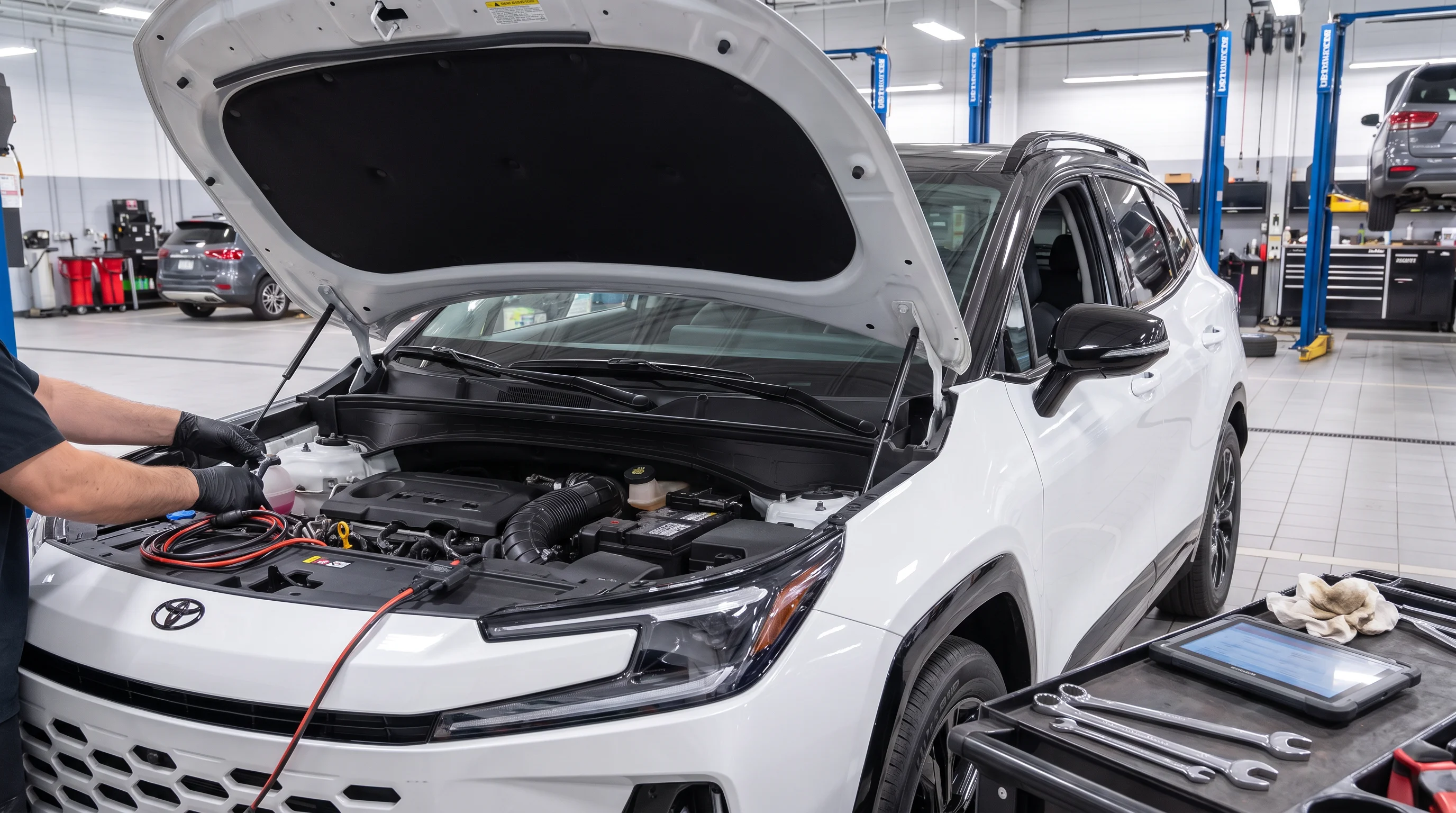
How Do Technicians Test Toyota Hybrid Battery Health During an Inspection?
Technicians test Toyota hybrid battery health by connecting Techstream, Toyota's factory diagnostic software, to the hybrid control system to read individual block voltages, internal resistance, state of charge behavior, and cooling fan performance. During the inspection, they monitor live data while the hybrid system is under load during acceleration and deceleration, watch for voltage differences between battery blocks, review thermal management data, and read active and stored diagnostic trouble codes to judge the pack's true condition.
Evaluating a high-voltage traction battery requires electronic monitoring rather than a simple physical check. A standard 12-volt battery tester, the kind used for your Toyota's conventional 12-volt battery, isn't built to assess a high-voltage nickel-metal hydride or lithium-ion hybrid pack. Instead, testing relies on continuous data captured while the hybrid system operates.
What Technicians Analyze During a Diagnostic Health Check
During a diagnostic health check, Toyota-trained technicians analyze several key operating parameters:
- Block voltage balance: Comparing voltage across the battery's monitored blocks under real-time electrical load.
- Internal resistance: Identifying blocks with rising resistance from aging modules or corroded connections.
- State of charge (SOC) behavior: Tracking how quickly charge levels swing during regenerative braking and engine-assisted charging.
- Thermal management and cooling fan operation: Checking fan operation, intake and ducting cleanliness, and pack temperature sensor readings.
- Stored fault code history: Retrieving active, pending, and stored codes and freeze-frame data from the hybrid control system.
First-time hybrid owners often ask whether a standard OBD2 code reader can pinpoint a bad cell. A generic reader can display a hybrid battery code, but it can't show the block-by-block voltage data needed to diagnose it. That's why technicians rely on factory diagnostic software that monitors live block data under real driving loads.
If your hybrid system is behaving differently, call 818-369-3922 or stop by our service center for a battery diagnostic assessment.
The information in this article is general guidance and does not constitute a specific diagnostic or repair recommendation for any individual vehicle. Repair and maintenance decisions should be made in consultation with a certified technician based on the specific condition of your vehicle.
Table of Contents
- What Does Diagnostic Trouble Code P0A80 Mean on a Toyota Hybrid?
- Key Indicators of Battery Degradation: Voltage Spread, Temperature, and Fuel Use
- Hybrid Battery Health Check vs. a Full Multi-Point Inspection
- Should You Service Your Toyota Hybrid at a Dealership or Independent Specialist in North Hollywood?
- Common Questions About Toyota Hybrid Battery Diagnostics and Warranty Coverage
- Schedule Your Toyota Hybrid Battery Diagnostic in North Hollywood
What Does Diagnostic Trouble Code P0A80 Mean on a Toyota Hybrid?
Diagnostic trouble code P0A80 translates to "Replace Hybrid Battery Pack." It sets when the hybrid battery monitoring unit detects a voltage difference between battery blocks that exceeds Toyota's standard. The code typically arrives with dashboard warnings, including the check engine light, the master warning indicator, and a hybrid system message, signaling that the system can no longer balance power delivery across the high-voltage pack.
A Toyota hybrid battery is made up of individual modules wired in series and grouped into monitored blocks. The hybrid system continuously samples voltage across those blocks. When the gap between the strongest and weakest block grows larger than factory parameters allow, the system logs P0A80.
Common Triggers Behind Code P0A80
Despite its name, P0A80 does not automatically mean the pack needs replacing. Toyota's repair procedure lists two possible trouble areas for this code: the high-voltage battery assembly and the battery monitoring unit itself. Common triggers include:
- Module capacity degradation: Naturally declining storage capacity in one or more modules due to age and mileage.
- Elevated internal resistance: Internal wear within specific blocks that limits how quickly they accept and deliver current.
- Corroded bus bars: Oxidation on the metal links connecting modules, creating voltage drops between neighbors.
- Overheating from restricted airflow: Toyota has issued a technical service bulletin noting that dust or debris in the hybrid battery cooling fan or filter can set P0A80 on several hybrid models, which is why keeping the battery cooling intake clean matters.
When P0A80 sets, the hybrid system may enter a protective fail-safe mode that reduces power and limits electric assist. Continuing to drive with an active hybrid battery code adds stress to other hybrid components, which is why prompt professional diagnosis matters. If a hybrid warning light also brought on your check engine light, our guide to the Toyota check engine light explains what that warning means.
The information in this article is general guidance and does not constitute a specific diagnostic or repair recommendation for any individual vehicle. Repair and maintenance decisions should be made in consultation with a certified technician based on the specific condition of your vehicle.
Key Indicators of Battery Degradation: Voltage Spread, Temperature, and Fuel Use
Key indicators of Toyota hybrid battery degradation include a widening voltage spread between battery blocks under load, a cooling fan that runs harder and more often, and a steady decline in the estimated fuel economy shown on your trip display. As module capacity fades, the gas engine has to run more often to maintain the battery's state of charge.
In a healthy pack, the monitored blocks stay closely matched during hard acceleration and regenerative braking. As modules age unevenly, that spread widens. Eventually the system struggles to calculate usable capacity, and you may see the battery charge indicator on the multi-information display drop from full to low in a matter of minutes.
Thermal management plays a parallel role in battery longevity. High-voltage batteries generate heat as they move energy, and the hybrid system monitors temperature sensors inside the pack and runs an electric cooling fan to keep it in range. Dusty conditions or a clogged battery cooling intake restrict airflow, which can leave the fan running continuously at high speed, an audible sign the battery is working to shed heat.
When the high-voltage pack loses usable storage, the vehicle relies more heavily on its gas engine, noticeably reducing the efficiency benefits you expect from Toyota hybrid engineering.
The information in this article is general guidance and does not constitute a specific diagnostic or repair recommendation for any individual vehicle. Repair and maintenance decisions should be made in consultation with a certified technician based on the specific condition of your vehicle.
EPA-estimated fuel economy figures are for comparison purposes only. Your actual mileage will vary depending on driving conditions, how you drive and maintain your vehicle, battery age/condition, and other factors.
Hybrid Battery Health Check vs. a Full Multi-Point Inspection
A standalone hybrid battery health check focuses on reading high-voltage trouble codes, comparing block voltages, and confirming cooling fan operation. A multi-point inspection looks at the whole vehicle, including braking systems, suspension, drive axles, fluid condition, and thermal management systems.
Hybrid Components a Thorough Inspection Covers
For hybrid owners, a thorough inspection also covers components a battery scan alone can miss, such as:
- High-voltage battery condition and state-of-charge behavior.
- Battery cooling intake filter condition, fan operation, and ducting clearance.
- Inverter coolant level.
A standalone battery scan offers a helpful snapshot, but a full inspection gives you a complete picture of high-voltage component health and overall vehicle reliability.
The information in this article is general guidance and does not constitute a specific diagnostic or repair recommendation for any individual vehicle. Repair and maintenance decisions should be made in consultation with a certified technician based on the specific condition of your vehicle.
Should You Service Your Toyota Hybrid at a Dealership or Independent Specialist in North Hollywood?
Servicing your Toyota hybrid at an authorized dealership gives you Toyota-trained technicians, factory Techstream diagnostics, genuine Toyota replacement parts, and direct handling of Toyota's hybrid warranty coverage. Independent shops in North Hollywood may advertise lower hourly labor rates or individual module repairs, but an authorized dealership provides manufacturer technical support and factory warranty administration.
- Factory diagnostic software: Technicians use Techstream, the same diagnostic software Toyota's repair procedures are written around.
- Warranty handling: Covered repairs, including high-voltage battery replacement on eligible 2020-and-newer models, are handled under Toyota's factory warranty.
- Genuine parts: Replacement battery assemblies, bus bars, and cooling fans are built to factory specifications rather than relying on refurbished third-party cells. Learn more about why OEM parts matter for your Toyota repair.
- Toyota-trained technicians: Our factory-trained technicians stay current on the latest Toyota technologies through ongoing training.
While some independent garages swap individual modules or recondition packs, those partial fixes can leave aged modules in place, which may lead to new voltage imbalances and repeat repairs. Servicing through an authorized dealer keeps components, software updates, and cooling system maintenance aligned with Toyota's standards.
Toyota Hybrid Warranty Coverage
| Coverage | Term | What's Covered |
|---|---|---|
| Hybrid Battery Warranty (MY2020 and newer) | 10 years from date of first use or 150,000 miles, whichever comes first | High-voltage hybrid battery |
| Hybrid System Warranty | 8 years or 100,000 miles, whichever comes first | Battery control module, hybrid control module, inverter with converter |
For a full breakdown of what's covered and how coverage is calculated, see our Toyota hybrid battery warranty guide.
This information is provided for general educational purposes only and does not constitute legal advice. Warranty coverage depends on the specific terms of your vehicle's warranty agreement. Consult your owner's manual or a qualified legal professional for guidance on your individual situation.
Common Questions About Toyota Hybrid Battery Diagnostics and Warranty Coverage
What is the factory warranty coverage on a new Toyota hybrid battery?
For model year 2020 and newer Toyota hybrid, plug-in hybrid, and fuel-cell vehicles, the high-voltage battery is covered for 10 years from the original date of first use or 150,000 miles, whichever comes first. Related hybrid components, including the battery control module, hybrid control module, and inverter with converter, are covered under Toyota's Hybrid System Warranty for 8 years or 100,000 miles, whichever comes first.
Can I drive my Toyota hybrid if the red master warning triangle lights up?
Driving with an active red master warning triangle or hybrid system fault message is not recommended. The warning means the hybrid control system has detected a fault, such as a block voltage imbalance or a cooling problem. Continued driving can stress the power inverter and transaxle, potentially turning a simple service need into a more extensive repair.
How often should the hybrid battery cooling filter be inspected?
Toyota's maintenance schedules call for inspecting the hybrid battery cooling intake filter at regular maintenance visits and cleaning it as needed; the exact interval depends on your model, so check your Warranty & Maintenance Guide. Drivers in dusty conditions or who regularly carry pets should check the intake vents more often, since blocked cooling ducts raise pack temperatures and can accelerate module wear.
How do technicians tell a healthy hybrid battery from a degraded one?
In a healthy pack, the voltages of the monitored blocks stay closely matched while the system is under load. When diagnostic testing shows a widening spread between the strongest and weakest blocks, the pack is losing balance, and once that difference exceeds Toyota's standard, the system sets fault codes like P0A80.
Does Toyota roadside assistance help if a hybrid battery fails on the road?
Toyota roadside assistance provides towing to the nearest Toyota dealership. Coverage is included with new Toyota models through ToyotaCare and comes with Toyota Certified Used Vehicles, so factory-backed towing support is available if a high-voltage system fault prevents normal driving. Call Toyota Roadside Assistance 24/7 at 1-800-444-4195.
This information is provided for general educational purposes only and does not constitute legal advice. Warranty coverage depends on the specific terms of your vehicle's warranty agreement. Consult your owner's manual or a qualified legal professional for guidance on your individual situation.
The information in this article is general guidance and does not constitute a specific diagnostic or repair recommendation for any individual vehicle. Repair and maintenance decisions should be made in consultation with a certified technician based on the specific condition of your vehicle.
Schedule Your Toyota Hybrid Battery Diagnostic in North Hollywood
Proper diagnostic testing and preventive cooling maintenance protect your hybrid's efficiency, long-term performance, and resale value. Whether your vehicle shows a warning light, is using more fuel than it used to, or is simply due for a multi-point health assessment, our Toyota-trained technicians provide the specialized care your hybrid needs.
To confirm warranty coverage or schedule a hybrid battery health check, call 818-369-3922 or visit our service team at 4606 Lankershim Blvd, North Hollywood, CA 91602.
Disclaimers
The information in this article is general guidance and does not constitute a specific diagnostic or repair recommendation for any individual vehicle. Repair and maintenance decisions should be made in consultation with a certified technician based on the specific condition of your vehicle.
EPA-estimated fuel economy figures are for comparison purposes only. Your actual mileage will vary depending on driving conditions, how you drive and maintain your vehicle, battery age/condition, and other factors.
This information is provided for general educational purposes only and does not constitute legal advice. Warranty coverage depends on the specific terms of your vehicle's warranty agreement. Consult your owner's manual or a qualified legal professional for guidance on your individual situation.