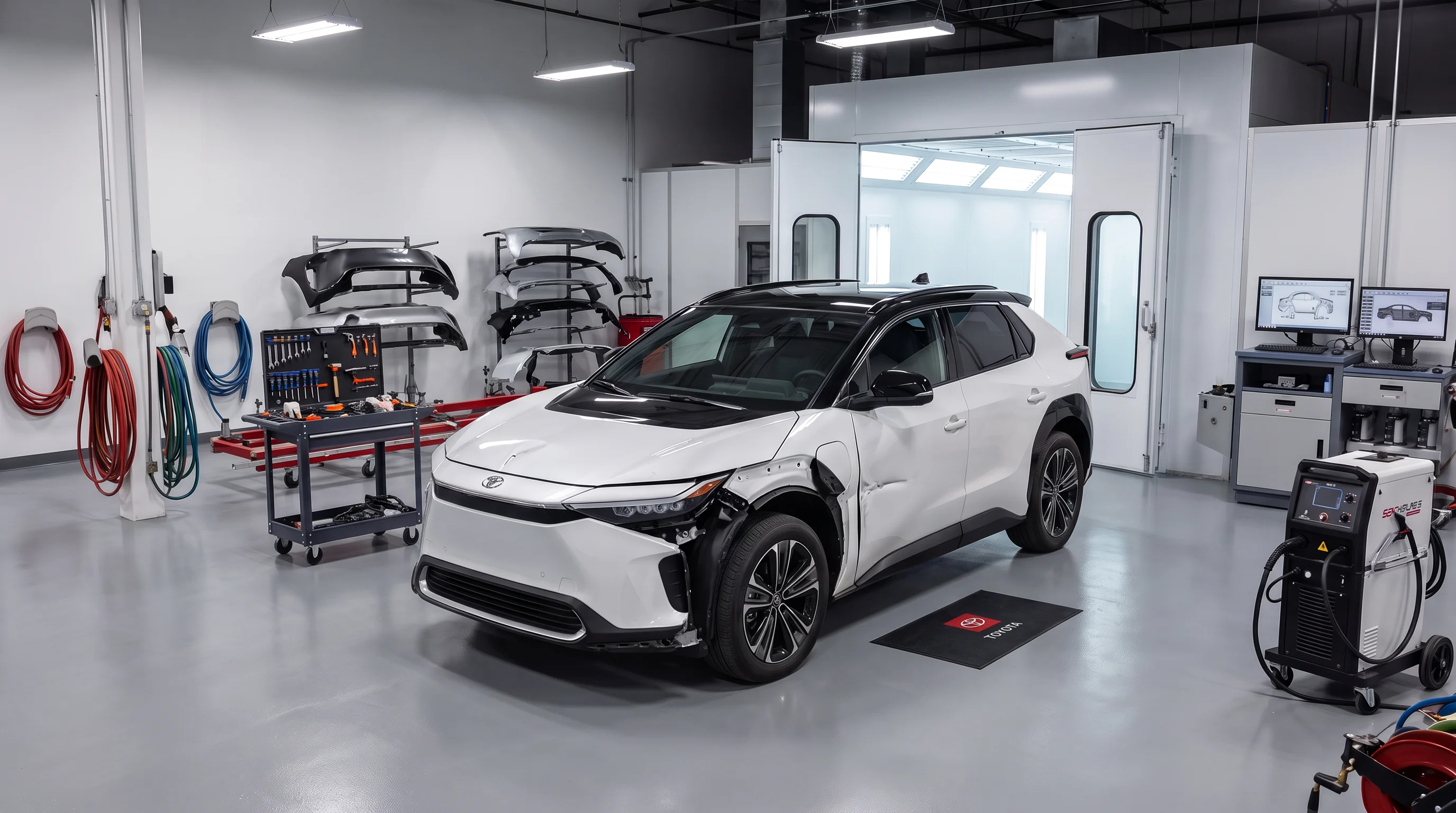
Toyota Collision Repair vs. Independent Body Shop: Why OEM Parts Matter
Toyota Collision Repair vs. Independent Body Shop: Why OEM Parts Matter
After a collision, the decision that matters most isn't which shop can take your Toyota soonest. It's which parts go back on it — and whether the shop follows Toyota's published procedures for installing them.
Those procedures have changed. Several repairs that were routine a decade ago are now prohibited outright on modern Toyota structures, and the reason comes down to the steel underneath the sheet metal.
⚠ One Rule Worth Knowing First
Toyota prohibits straightening high-strength and ultra-high-strength occupant cabin reinforcements, hot or cold. Damaged ones must be replaced with Genuine New OE Service Parts.
What follows is what Toyota actually requires, what testing found when non-certified crash parts were measured against factory parts, and how to tell the difference on a written estimate.
What Toyota Certification Actually Requires
Benchmarks, annual re-qualification, and dedicated tooling
Toyota Certified Collision Centers must meet benchmarks across ten key areas including technician training and certification, tools and equipment, and customer satisfaction, and dealers must re-qualify for the program annually. Required equipment includes aluminum welding equipment kept separate from steel welding tools to prevent cross-contamination and corrosion, along with vehicle measuring systems that verify structural geometry against factory specifications. For a deeper look at those benchmarks, see the full certification standards.
What Certification Adds
| Factor | Toyota Certified Collision Center | Non-Certified Shop |
|---|---|---|
| Annual re-qualification audit | Required every year to keep certified status | Not applicable |
| Ten-area benchmark compliance | Required across training, tooling, process and customer satisfaction | Not applicable |
| Brand-specific technician training | Toyota Collision Repair & Refinish training plus ASE certification | Varies by shop; no Toyota-specific requirement |
| Aluminum welding separation | Dedicated equipment required to prevent cross-contamination and corrosion | Varies by shop |
| Structural measuring systems | Required to verify structural geometry against factory specifications | Varies by shop |
| Toyota Genuine Parts access | Dealer parts operation on site | Ordered through a dealer |
💡 The Short Version
Annual auditing, brand-specific training, dedicated aluminum tooling, structural measuring systems, and on-site Genuine Parts access are what Toyota certification requires and verifies.
What Toyota's Repair Bulletins Say About Structural Parts
Some components can't be straightened at all — per Toyota, not per us
Replace, Don't Repair
Toyota publishes Collision Repair Information Bulletin #175, titled HSS & UHSS Cabin Reinforcement Repair & Replacement. Its position is unambiguous: once a reinforcement is deformed by an impact, the integrity of the steel is compromised, and straightening it by any repair method makes the condition worse. Damaged high-strength and ultra-high-strength steel occupant cabin reinforcements must be replaced with Genuine New OE Service Parts.
Toyota states the basis for that position directly — a reduction in reinforcement strength and crash energy management revealed during research and testing conducted by Toyota Motor Corporation, with repaired or improperly sectioned reinforcements failing to exhibit the strength and performance ratings of genuine new original equipment service parts installed to specification.
What Toyota CRIB #175 Prohibits and Requires
| Repair Action | Toyota's Position | Applies To |
|---|---|---|
| Straightening, hot or cold | Prohibited | All HSS and UHSS occupant cabin reinforcements |
| Sectioning pillar reinforcements | Prohibited | 980 MPa and 590 MPa pillar reinforcements |
| Sectioning 440 MPa parts | Permitted only where specified | Where Toyota service information explicitly allows it |
| Replacement | Required | Genuine New OE Service Parts only |
| Using heat to straighten body or frame components | Prohibited | All Toyota, Lexus and Scion vehicles |
| Cold straightening a "bend" | Permitted | Deformation that can be returned to original shape |
| Repairing a "kink" | Replace instead | Deformation that cannot be returned to shape by cold straightening |
Heat and welding positions above are drawn from Toyota's 2022 Collision Repair Information Bulletin covering straightening and welding technique, which applies to all Toyota, Lexus and Scion vehicles.
Which Components Count as Cabin Reinforcements
The restriction covers more parts than most drivers expect. Per Toyota's bulletin, occupant cabin reinforcements include pillar, rocker panel and roof rail reinforcements — and also:
- Roof bows
- Floor crossmembers
- Door beams
- The rear bulkhead
Any of those parts made of high-strength steel or stronger cannot be repaired. It gets replaced.
Why the Steel Grade Is the Reason
Modern Toyota cabins aren't built from one kind of steel. The 2016 Tacoma cabin was constructed from 440, 590, 980 and 1480 MPa steel — the first time Toyota used 1480 MPa material — and the strength of its cabin reinforcements tripled compared with the previous model. Toyota later adopted a 1470 MPa ultra-high-tensile front pillar upper outer, a first for the brand.
Model-specific Collision Damage Repair Manuals identify the location and strength rating of every one of those panels in the Structural Outline section. A repair plan that doesn't consult them is guessing at which components can be repaired and which must be replaced.
Service & Repair Disclaimer: The information in this article is general guidance and does not constitute a specific diagnostic or repair recommendation for any individual vehicle. Repair and maintenance decisions should be made in consultation with a certified technician based on the specific condition of your vehicle.
What Testing Found in Non-Certified Crash Parts
Read the numbers, and read the date on them
Why "Aftermarket" Usually Means "Non-Certified"
The Certified Automotive Parts Association is a non-profit that certifies aftermarket crash parts against its own standards. The important context is how rarely that certification is actually present: CAPA has estimated that 75 to 80 percent of the CAPA-certifiable parts used by collision repairers are not CAPA certified. So when an estimate lists an aftermarket crash part, the odds are it carries no third-party certification at all.
The CAPA Quality Watch Findings
In its first Quality Watch report, CAPA purchased 15 popular non-certified aftermarket parts and compared them against car company brand parts. Two caveats belong with these numbers: the sample was 15 parts, and the report dates to the early 2010s — CAPA's second Quality Watch report was published in February 2012. Treat it as an indicator of what uncertified parts can look like, not as a current market survey.
CAPA Quality Watch Report #1: 15 Non-Certified Parts Tested
| What CAPA Measured | What It Found |
|---|---|
| Overall comparability | 13 of 15 parts showed significant differences, most with serious deficiencies |
| Metal body part strength | 6 of 7 failed to match the yield and tensile strength of the car company brand parts |
| Yield strength shortfall | Up to 31 percent lower than the OEM part |
| Tensile strength shortfall | Up to 18 percent lower than the OEM part |
| Corrosion protection | Non-galvanized steel used in place of galvanized |
| Hardware quality | Weak hood strikers and hinge fasteners |
| Construction integrity | One hood was missing the reinforcement plate between the hood striker and the outer skin entirely |
What This Does and Doesn't Prove
- The findings apply to non-certified aftermarket parts, not to every aftermarket part. CAPA's own 501 Bumper Parts Standard includes a series of full-part dynamic crash tests for certified bumper parts.
- The evidence on comparative crash performance is genuinely contested. The Insurance Institute for Highway Safety has analyzed crash data and concluded aftermarket parts performed comparably to OEM parts in at least one test, though that result was specific to a single make, model and parts set — a dispute the collision trade press has covered at length.
- What isn't contested is the manufacturer's own position on its own vehicles — which is the bulletin in the previous section.
⚠ Check the Estimate, Not the Panel
"Aftermarket" and "non-certified aftermarket" are not the same thing. The distinction shows up on the written estimate, where every crash part has to be identified.
Parts That Touch Your Toyota's Safety Sensors
Recalibration is triggered by proximity to a sensor, not by visible damage
When Recalibration Becomes Part of the Repair
Recalibration is required when a repair affects components in or near a sensor location, including:
- The front bumper
- The front grille area
- The windshield
- The rear bumper
- Door mirror assemblies on vehicles equipped with Blind Spot Monitor
Toyota's millimeter-wave sensor sits behind the front grille and works with the pre-collision system to judge distance to vehicles and objects ahead, which is why a bumper cover bracket is a safety component and not just a cosmetic one.
The Scan Toyota Requires Before and After
Per Toyota Collision Repair Information Bulletin #191, it is necessary for repairers to perform a "Health Check" diagnostic scan before and after every repair when a vehicle has sustained collision damage. Toyota's Techstream and Techstream Lite scan tools and software retrieve and report all diagnostic trouble codes for Toyota, Lexus and Scion vehicles — and not all trouble codes illuminate a warning light on the dash. A car with a clean dashboard can still be carrying stored faults.
The Sequence
- Pre-repair Health Check scan — records stored and pending diagnostic trouble codes before any work begins
- Structural and panel repair — verified against factory measurements
- Static calibration — performed in a controlled shop environment using model-specific targets
- Dynamic calibration — validated on a driven road loop
- Post-repair Health Check scan — documented and printed for the file
For a closer look at how static and dynamic recalibration differ, see our certified collision center guide.
The Equipment, by Name
Toyota and Lexus approved Hunter Engineering's Ultimate ADAS for their North American dealer and collision network in September 2025. Toyota separately approved the John Bean Tru-Point ADAS calibration tool for service and repair on Toyota vehicles in the United States. Ask any shop which approved system it uses — and whether you'll receive the calibration report.
Toyota Safety Sense Generations
Calibration procedures are generation-specific, so the model year on your registration matters to the repair plan.
| Generation | Where It Appears | Notes |
|---|---|---|
| Toyota Safety Sense 3.0 | The most widely fitted suite across the current Toyota lineup | Pre-Collision System with Pedestrian Detection, Lane Departure Alert with Steering Assist, Lane Tracing Assist, Full-Speed Range Dynamic Radar Cruise Control, Automatic High Beams, Road Sign Assist |
| Toyota Safety Sense 4.0 | 2026 RAV4 and RAV4 Plug-in Hybrid | Standard on every 2026 RAV4 trim; runs on Toyota's Arene software platform with updated hardware and detection capability |
| Toyota Safety Sense 2.5 | 2026 Sequoia | Retained to suit the vehicle's larger dynamics |
TSS 4.0 content confirmed via Toyota USA Newsroom and Toyota.com.
Model-Year Specifications Disclaimer: Toyota Safety Sense feature content, generation availability, and calibration requirements are preliminary and subject to change. Figures and availability are current as of September 2026 per Toyota press materials. Confirm details for your specific model year with North Hollywood Toyota.
Service & Repair Disclaimer: The information in this article is general guidance and does not constitute a specific diagnostic or repair recommendation for any individual vehicle. Repair and maintenance decisions should be made in consultation with a certified technician based on the specific condition of your vehicle.
What You Get at North Hollywood Toyota's Collision Center
Toyota and all major brands, repaired with genuine OEM parts
Our collision center at 4606 Lankershim Blvd handles everything from minor dent and bumper repair to complex structural reconstruction, and we manage the process from drop-off to pickup.
Included With Every Repair
| What We Offer | What That Means for You |
|---|---|
| Free local towing | We come to you — towing to our shop at no charge |
| Free car rental | Keep moving while your vehicle is being restored |
| Free shuttle service | Drop-off and pickup throughout North Hollywood and surrounding communities |
| Lifetime warranty | All repair work backed by our lifetime guarantee on workmanship |
| On-site written estimate | A transparent, detailed quote prepared before any work begins |
| Insurance assistance | We work with all insurance companies to simplify your claims process |
Choosing Where the Work Happens
If you're weighing an insurer's recommended shop against your own choice, you have the right to choose where your Toyota is repaired in California.
Frequently Asked Questions
Common questions about Toyota collision parts and repair procedure
Can a damaged structural reinforcement on my Toyota be straightened instead of replaced?
For high-strength and ultra-high-strength steel occupant cabin reinforcements, no. Toyota CRIB #175 instructs repairers not to straighten those reinforcements hot or cold, and not to section pillar reinforcements at 980 MPa or 590 MPa. Those components must be replaced with Genuine New OE Service Parts.
Are CAPA-certified aftermarket parts the same as Toyota Genuine Parts?
They aren't the same thing, but they also aren't what CAPA's testing flagged. CAPA's Quality Watch findings covered non-certified aftermarket parts, and CAPA has estimated that 75 to 80 percent of certifiable parts used by repairers carry no certification. CAPA's own 501 standard for certified bumper parts includes full-part dynamic crash testing. The distinction to watch for on an estimate is whether a part is certified at all.
Can I tell by looking whether a genuine part was installed?
Often not. The California Department of Insurance has noted that crash parts can be difficult to identify as OEM or aftermarket because manufacturer's markings get painted over, covered with body filler, or wear off. The reliable method is the paperwork, not the panel.
Does my Toyota's parts warranty depend on where the work is done?
Genuine Toyota parts carry a Service Parts Limited Warranty of 12 months regardless of mileage from the install date, or the remainder of any applicable New Vehicle Limited Warranty, whichever provides greater coverage. Toyota also states that damage to a Toyota part or accessory caused by a non-genuine or unauthorized part or component is not covered.
Warranty Disclaimer: This information is provided for general educational purposes only and does not constitute legal advice. Warranty coverage depends on the specific terms of your vehicle's warranty agreement. Consult your owner's manual or a qualified legal professional for guidance on your individual situation.
Disclaimers
Service & Repair
The information in this article is general guidance and does not constitute a specific diagnostic or repair recommendation for any individual vehicle. Repair and maintenance decisions should be made in consultation with a certified technician based on the specific condition of your vehicle.
Warranty
This information is provided for general educational purposes only and does not constitute legal advice. Warranty coverage depends on the specific terms of your vehicle's warranty agreement. Consult your owner's manual or a qualified legal professional for guidance on your individual situation.
Model-Year Specifications
Toyota Safety Sense feature content, generation availability, and calibration requirements are preliminary and subject to change. Figures and availability are current as of September 2026 per Toyota press materials. Confirm details for your specific model year with North Hollywood Toyota.
Bring Your Toyota to Our Collision Center
Genuine OEM parts, Toyota repair procedures, and a lifetime warranty on workmanship — start with a free written estimate.
Visit us at 4606 Lankershim Blvd, North Hollywood, CA 91602