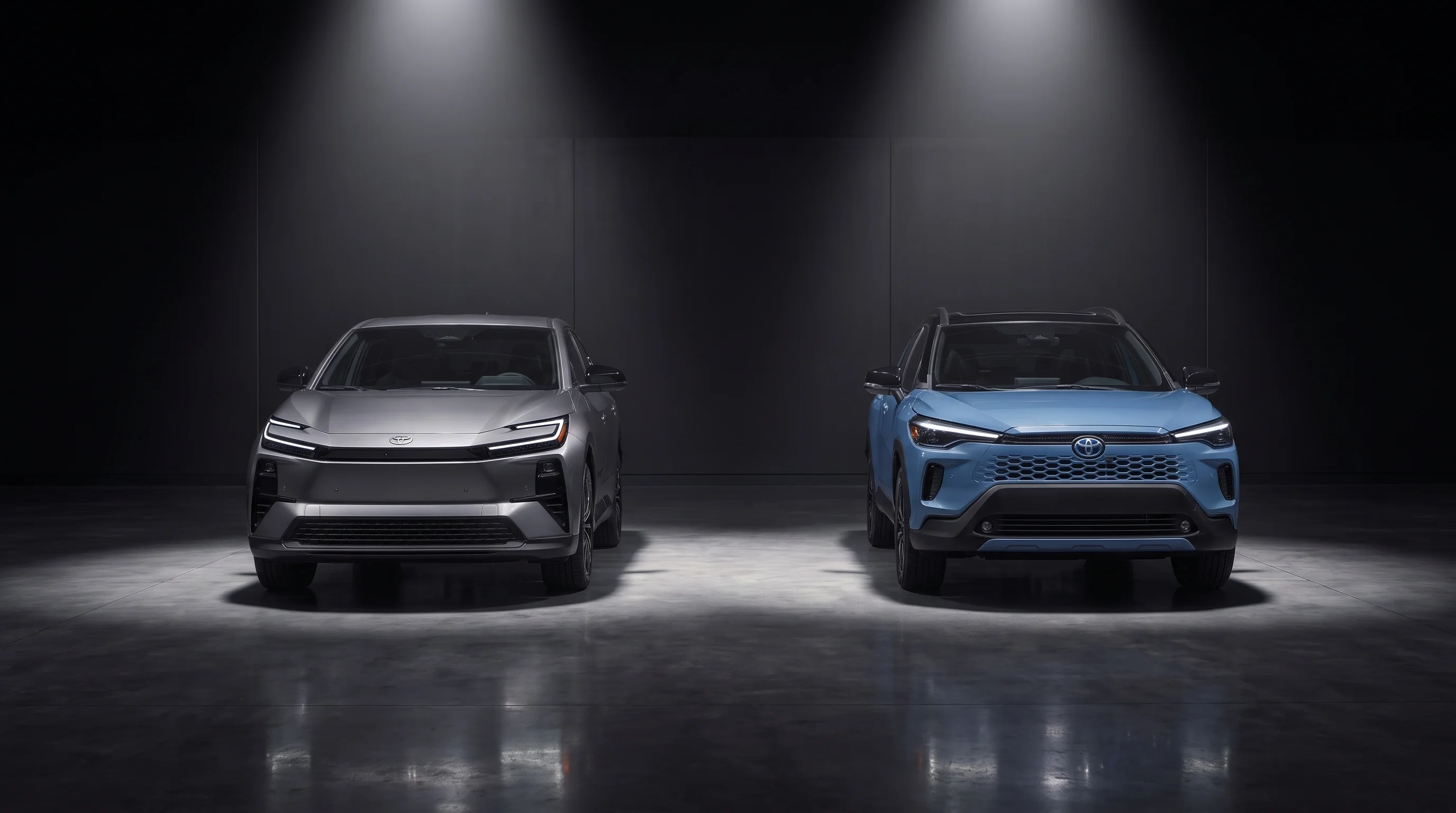
2026 Toyota C-HR vs Corolla Cross: Which Compact SUV Fits You?
2026 Toyota C-HR vs Corolla Cross: Which Compact SUV Fits You?
The 2026 Toyota C-HR and 2026 Toyota Corolla Cross both wear the compact SUV badge, but they solve different problems for different budgets. The C-HR is an all-electric crossover with standard all-wheel drive and 338 horsepower. The Corolla Cross is a gas or hybrid SUV that starts roughly $12,000 lower on TSRP. Neither one is the better vehicle in the abstract — the right answer depends on how you drive, where you park, and what you want to spend. Here is how they actually compare across all eight grades — Toyota's term for what most shoppers call trims.
At a Glance
| Category | 2026 Toyota C-HR | 2026 Toyota Corolla Cross |
|---|---|---|
| Powertrain | All-electric (BEV) | 2.0L gas or 2.0L hybrid |
| Grades | 2 (SE, XSE) | 6 (L, LE, XLE, Hybrid S, SE, XSE) |
| Drivetrain | AWD standard | FWD or AWD (gas), AWD standard (hybrid) |
| Horsepower | 338 hp | 169 hp gas, 196 hp hybrid |
| Starting TSRP | $38,450 | $26,085 |
| Refueling | Plug in — NACS port | Gas station |
Total Suggested Retail Price (TSRP) for new vehicles includes manufacturer and distributor options and delivery, processing, and handling fees, which are subject to change at any time. TSRP excludes taxes, title, license, dealer-installed options, accessories, fees and charges. TSRP is not the dealer advertised price. Dealer price will vary. The dealer sets the final price.
How Do the 2026 C-HR and Corolla Cross Lineups Compare on Price?
Six Corolla Cross grades across two powertrains, two all-electric C-HR grades
The Corolla Cross covers six grades across two powertrains. The C-HR covers two, both electric and both all-wheel drive. That structural difference explains most of the price gap.
Full Lineup Pricing
| Grade | Powertrain | Drivetrain | Starting TSRP |
|---|---|---|---|
| Corolla Cross L | 2.0L gas | FWD (AWD available) | $26,085 |
| Corolla Cross LE | 2.0L gas | FWD (AWD available) | $28,415 |
| Corolla Cross XLE | 2.0L gas | FWD (AWD available) | $31,010 |
| Corolla Cross Hybrid S | 2.0L hybrid | AWD standard | $30,445 |
| Corolla Cross Hybrid SE | 2.0L hybrid | AWD standard | $31,765 |
| Corolla Cross Hybrid XSE | 2.0L hybrid | AWD standard | $34,480 |
| C-HR SE | Dual-motor electric | AWD standard | $38,450 |
| C-HR XSE | Dual-motor electric | AWD standard | $40,450 |
What the Money Buys You
- Lowest entry cost — the gas Corolla Cross L is the least expensive way into a Toyota compact SUV.
- Best efficiency per dollar — the Corolla Cross Hybrid adds standard AWD and a large fuel-economy jump for roughly $4,400 over the base gas grade on TSRP.
- Most standard equipment — the C-HR SE arrives with a 14-inch touchscreen, heated front seats and steering wheel, a power liftgate, and dual wireless chargers as standard.
- AWD strategy differs — every C-HR and every Corolla Cross Hybrid is all-wheel drive from the factory; on gas grades, AWD is an added-cost option.
For a grade-by-grade breakdown of the hybrid lineup, see our 2026 Corolla Cross Hybrid trims and pricing guide.
Total Suggested Retail Price (TSRP) for new vehicles includes manufacturer and distributor options and delivery, processing, and handling fees, which are subject to change at any time. TSRP excludes taxes, title, license, dealer-installed options, accessories, fees and charges. TSRP is not the dealer advertised price. Dealer price will vary. The dealer sets the final price.
How Do Performance and Driving Feel Differ?
338 electric horsepower against a proven gas and hybrid pairing
Powertrain Specifications
| Specification | C-HR | Corolla Cross Gas | Corolla Cross Hybrid |
|---|---|---|---|
| Horsepower | 338 hp | 169 hp | 196 hp |
| Torque | 323 lb-ft combined | 151 lb-ft @ 4,400 rpm | 139 lb-ft @ 4,400 rpm (gas engine) |
| Transmission | Single-speed | CVTi-S | eCVT |
| Drivetrain | AWD standard | FWD or AWD | AWD standard |
| 0–60 mph | 4.9 sec (mfr. est.) | Not published by Toyota | 8 sec (mfr. est.) |
Toyota publishes a manufacturer-estimated 4.9-second 0–60 mph time for the C-HR and a manufacturer-estimated 8-second 0–60 mph time for the Corolla Cross Hybrid. Toyota does not publish a 0–60 mph figure for gas Corolla Cross grades. Performance figures are for comparison only and were obtained with prototype vehicles by professional drivers. All specifications on this page are sourced from Toyota Motor Sales, U.S.A., Inc. product information for the 2026 C-HR and 2026 Corolla Cross and are subject to change.
The C-HR's Approach
- Dual electric motors housed in front and rear eAxles, producing 338 net combined horsepower.
- Underfloor battery pack lowers the center of gravity; suspension springs, dampers, and anti-roll bars were tuned specifically for this model.
- Steering-wheel paddle shifters adjust regenerative braking across four levels.
- No engine noise, and full torque available immediately from a stop.
The Corolla Cross's Approach
- Gas grades use a 2.0-liter four-cylinder with a CVTi-S transmission — adequate for commuting, unremarkable under hard acceleration.
- Hybrid grades pair a 2.0-liter engine with three electric motors and Toyota's fifth-generation hybrid system through an eCVT.
- Hybrid all-wheel drive is electronic on-demand: a rear electric motor engages automatically when grip is lost.
What Are the Fuel Economy and Range Ratings?
Two different answers to the same question: how far, and how often do you stop?
Efficiency and Range by Configuration
| Model | EPA-Estimated Efficiency | Range |
|---|---|---|
| C-HR SE | 127 city / 107 hwy / 117 combined MPGe | EPA-estimated 287 miles |
| C-HR XSE | 122 city / 102 hwy / 112 combined MPGe | EPA-estimated 273 miles |
| Corolla Cross Hybrid (all grades) | 46 city / 39 hwy / 42 combined MPG | Est. ~445 miles per tank (calculated) |
| Corolla Cross Gas FWD | 31 city / 33 hwy / 32 combined MPG | Est. ~397 miles per tank (calculated) |
| Corolla Cross Gas AWD | 29 city / 31 hwy / 30 combined MPG | Est. ~396 miles per tank (calculated) |
Corolla Cross range figures are calculated from EPA-estimated combined fuel economy and tank capacity — 10.6 gallons on hybrid grades, 12.4 gallons on front-wheel-drive gas grades, and 13.2 gallons on all-wheel-drive gas grades. They are estimates only and are not EPA-published range ratings. Actual range varies with driving conditions.
Charging the C-HR
- Standard North American Charging System (NACS) port, with a NACS-to-CCS adapter included.
- DC fast charging takes the battery from 10% to 80% in about 30 minutes under ideal conditions.
- An 11-kW onboard charger handles Level 2 charging; a 10% to 100% charge takes roughly 7 to 8 hours on a 240-volt connection.
- Battery preconditioning warms the pack ahead of fast charging, either manually or automatically when a charger is set as the navigation destination (automatic activation requires an active Drive Connect trial or subscription).
- Plug & Charge support authenticates automatically at participating networks (requires an active Remote Connect trial or subscription).
Fueling the Corolla Cross
- No plug, no charging schedule, no home electrical work.
- The hybrid recharges its own battery through regenerative braking and engine power.
- A 10.6-gallon tank at an EPA-estimated 42 combined MPG works out to an estimated 445 miles between stops.
Charging Access Is the Real Decision
The C-HR makes the most sense when you can charge where you park overnight. If you rely on street parking or a building without charger access, the Corolla Cross Hybrid delivers strong efficiency without changing anything about your routine.
EPA-estimated fuel economy figures are for comparison purposes only. Your actual mileage will vary depending on driving conditions, how you drive and maintain your vehicle, battery age/condition, and other factors.
Which One Holds More Cargo and Passengers?
Both seat five — the difference is behind the rear seats
Cargo and Dimensions
| Measurement | C-HR | Corolla Cross Hybrid |
|---|---|---|
| Seating | 5 | 5 |
| Cargo behind rear seats | 25.3 cu ft | 21.5 cu ft |
| Maximum cargo, seats folded | 59.5 cu ft | Up to 52.0 cu ft (Corolla Cross lineup figure) |
| Wheelbase | 108.3 in | 103.9 in |
| Overall length | 177.9 in | 176.8 in |
| Overall width | 73.6 in | 71.9 in |
| Energy storage | 74.7 kWh battery | 10.6 gal fuel tank |
Toyota publishes up to 52.0 cubic feet of cargo volume for the Corolla Cross with the 60/40 split-folding rear seatbacks folded, and does not publish a separate seats-folded figure for hybrid grades. Cargo and load capacity are limited by weight and distribution.
Practical Takeaways
- The C-HR carries more in both configurations — nearly four additional cubic feet behind the rear seats and roughly seven and a half more with them folded.
- Gas Corolla Cross models with front-wheel drive open up to 24 cubic feet behind the rear seats; all-wheel-drive hardware reduces that to 21.5.
- Both use 60/40 split-folding rear seatbacks.
- The C-HR's sloping roofline limits tall loads even though total volume is larger.
- The Corolla Cross is narrower, which makes tight parking structures easier and three-across rear seating harder.
How Do the Technology and Safety Features Compare?
Toyota Safety Sense 3.0™ is standard on every grade of both models
Feature Availability
| Feature | C-HR | Corolla Cross |
|---|---|---|
| Touchscreen | 14-inch standard on both grades | 8-inch standard; 10.5-inch standard on XLE and Hybrid XSE, available on LE and Hybrid SE |
| Wireless Apple CarPlay® / Android Auto™ | Standard | Standard |
| Wireless charging | Two front pads standard | Standard on LE, SE, XLE, XSE |
| Toyota Safety Sense 3.0™ | Standard | Standard on every grade |
| Blind Spot Monitor w/ Rear Cross-Traffic Alert | Standard | Standard on LE, XLE, Hybrid SE, Hybrid XSE |
| Front & Rear Parking Assist w/ Automatic Braking | Standard | Standard on XLE and Hybrid XSE |
| Panoramic View Monitor | XSE | — |
| Traffic Jam Assist | XSE (requires an active Drive Connect trial or subscription) | — |
| JBL® Premium Audio (9 speakers) | Available on XSE | Available on XLE and XSE |
Standard on Both Vehicles, Every Grade
- Pre-Collision System with Pedestrian Detection
- Full-Speed Range Dynamic Radar Cruise Control
- Lane Departure Alert with Steering Assist
- Lane Tracing Assist
- Road Sign Assist
- Automatic High Beams
- Proactive Driving Assist
- Toyota's Star Safety System™
Toyota Safety Sense 3.0 and driver assist features are not a substitute for safe and attentive driving.
What Warranty and Maintenance Coverage Comes with Each?
Identical basic and powertrain terms, with coverage that varies by powertrain
Coverage Comparison
| Coverage | C-HR | Corolla Cross |
|---|---|---|
| Basic | 36 months / 36,000 miles | 36 months / 36,000 miles |
| Powertrain | 60 months / 60,000 miles | 60 months / 60,000 miles |
| Electric or hybrid system components | 8 years / 100,000 miles | 8 years / 100,000 miles |
| Traction or hybrid battery | 8 years / 100,000 miles | 10 years / 150,000 miles |
| ToyotaCare scheduled maintenance | 2 years / 25,000 miles | 2 years / 25,000 miles |
| Roadside assistance | 3 years, regardless of mileage | 2 years, regardless of mileage |
Confirm Battery Coverage on the Specific Vehicle
Toyota publishes battery coverage separately for hybrid and battery-electric vehicles, and the terms can differ by program and model year. Before you buy, confirm the exact battery coverage on the specific vehicle you are considering in its Warranty & Maintenance Guide.
Coverage terms above are published by Toyota Motor Sales, U.S.A., Inc. in the 2026 C-HR and 2026 Corolla Cross product releases, and in each vehicle's Warranty & Maintenance Guide.
This information is provided for general educational purposes only and does not constitute legal advice. Warranty coverage depends on the specific terms of your vehicle's warranty agreement. Consult your owner's manual or a qualified legal professional for guidance on your individual situation.
Common Questions About the C-HR and Corolla Cross
Quick answers to what shoppers ask most
Is the 2026 Toyota C-HR fully electric?
Yes. The C-HR returned to the U.S. lineup for 2026 as a battery electric vehicle built on Toyota's dedicated e-TNGA platform. It has no gas engine and is not offered as a hybrid.
Does the Corolla Cross come as an electric vehicle?
No. The Corolla Cross is offered with a 2.0-liter gas engine or as a self-charging hybrid. The hybrid has no charging port and never needs to be plugged in.
Which one is less expensive?
The Corolla Cross, by a wide margin. Gas grades start at $26,085 TSRP and hybrid grades at $30,445 TSRP, against $38,450 TSRP for the C-HR SE.
Where can I fast-charge the 2026 C-HR?
Every C-HR uses a North American Charging System (NACS) charge port, which opens access to thousands of public DC fast-charging stations and Level 2 chargers nationwide. A NACS-to-CCS adapter is also included for stations using the older connector.
Which one holds more cargo?
The C-HR — 25.3 cubic feet behind the rear seats and 59.5 with them folded. The Corolla Cross Hybrid offers 21.5 cubic feet behind the rear seats, and Toyota publishes up to 52.0 cubic feet for the Corolla Cross with the rear seatbacks folded.
Where can I see both in North Hollywood?
North Hollywood Toyota stocks both models at 4606 Lankershim Blvd. Call 818-369-3922 or use the contact link on this page to arrange a test drive in either one.
Total Suggested Retail Price (TSRP) for new vehicles includes manufacturer and distributor options and delivery, processing, and handling fees, which are subject to change at any time. TSRP excludes taxes, title, license, dealer-installed options, accessories, fees and charges. TSRP is not the dealer advertised price. Dealer price will vary. The dealer sets the final price.
Which One Fits You?
Both are legitimate answers — they answer different questions
Both vehicles are legitimate answers — they just answer different questions. Our 2026 C-HR specs and trims breakdown and 2026 Corolla Cross Hybrid overview go deeper on each.
Choose the Corolla Cross If…
- Purchase price is the deciding factor — it starts roughly $12,000 below the C-HR on TSRP.
- You want strong fuel economy without changing how you refuel.
- You park on the street or in a building without charger access.
- You take frequent long drives and prefer five-minute fill-ups.
- You want the longest battery coverage in this pairing.
Choose the C-HR If…
- You can charge at home or at work and want to stop buying gas.
- You want standard all-wheel drive without paying extra for it.
- Acceleration matters — 338 horsepower and 4.9 seconds to 60 mph is a different category of quick.
- You need the larger cargo hold.
- You want the most standard technology, including the 14-inch touchscreen on the base grade.
Our C-HR electric review covers the ownership side in more detail. The most useful next step is driving both — the difference between them is something you feel in the first mile.
Total Suggested Retail Price (TSRP) for new vehicles includes manufacturer and distributor options and delivery, processing, and handling fees, which are subject to change at any time. TSRP excludes taxes, title, license, dealer-installed options, accessories, fees and charges. TSRP is not the dealer advertised price. Dealer price will vary. The dealer sets the final price.
Drive Both at North Hollywood Toyota
We stock the 2026 C-HR and the full 2026 Corolla Cross lineup, serving North Hollywood, Toluca Lake, Valley Village, Burbank, Studio City, Sun Valley, and Valley Glen.
Visit us at 4606 Lankershim Blvd, North Hollywood, CA 91602