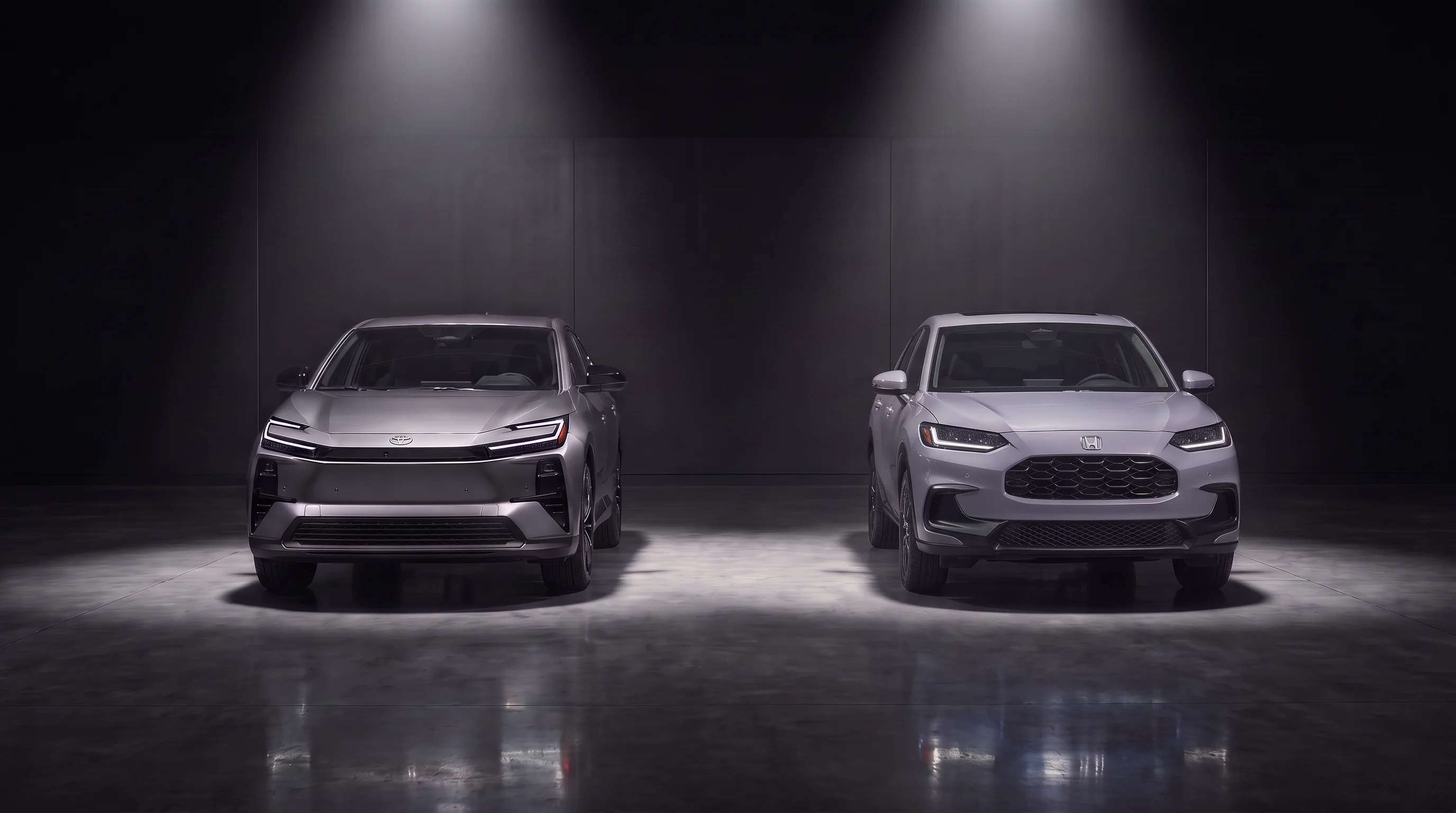
2026 Toyota C-HR vs. 2026 Honda HR-V: Electric Performance Meets Subcompact Value
2026 Toyota C-HR vs. 2026 Honda HR-V: Electric Performance Meets Subcompact Value
The 2026 Toyota C-HR arrives as an all-electric crossover with 338 net combined system horsepower, standard All-Wheel Drive, and an EPA-estimated 287-mile range. The 2026 Honda HR-V stays with a 158-hp gas four-cylinder and a lower entry price. These two take genuinely different paths, and this comparison lays out where each one earns its keep for drivers in North Hollywood, Burbank, Studio City, and the surrounding Valley.
At a Glance
The headline numbers, side by side
| Specification | 2026 Toyota C-HR | 2026 Honda HR-V |
|---|---|---|
| Powertrain | Dual-motor electric | 2.0L 4-cylinder gas |
| Horsepower | 338 hp | 158 hp |
| Drivetrain | AWD standard | FWD standard, AWD available |
| Efficiency | Up to an EPA-estimated 117 MPGe combined | EPA-estimated 28 MPG combined |
| Range | Up to an EPA-estimated 287 miles | Gasoline, 14-gallon tank |
| Starting price | TSRP $38,395* | MSRP $27,650* |
| Trims available | 2 | 3 |
*Toyota C-HR pricing shown as TSRP. Honda HR-V pricing shown as MSRP for the front-wheel-drive LX. See the full TSRP and MSRP disclosures in the pricing section below.
Specifications and availability are preliminary and subject to change. Toyota C-HR figures are sourced from Toyota's official 2026 C-HR product release and toyota.com; Honda HR-V figures are sourced from Honda's 2026 HR-V Pricing and EPA Ratings and 2026 HR-V Specifications & Features releases at hondanews.com. Verified as of August 20, 2026.
How Do Prices Compare?
Every 2026 trim in both lineups
Complete 2026 Lineup Pricing
| Model | Trim | Price (TSRP / MSRP) |
|---|---|---|
| Toyota C-HR | SE AWD | TSRP $38,395* |
| Toyota C-HR | XSE AWD | TSRP $40,395* |
| Honda HR-V | LX (FWD) | MSRP $27,650* |
| Honda HR-V | LX (AWD) | MSRP $29,150* |
| Honda HR-V | Sport (FWD) | MSRP $29,450* |
| Honda HR-V | Sport (AWD) | MSRP $30,950* |
| Honda HR-V | EX-L (FWD) | MSRP $31,500* |
| Honda HR-V | EX-L (AWD) | MSRP $33,000* |
Roughly $10,700 separates a base HR-V from a base C-HR. What that money buys is a different class of powertrain. The two lineups are also structured differently: the HR-V spreads $3,850 across three front-wheel-drive trims and asks $1,500 more for All-Wheel Drive on any of them, while the C-HR covers $2,000 between its two grades and gives both the same standard All-Wheel Drive powertrain.
That last point matters when you compare like for like. Because every C-HR is All-Wheel Drive, the fairest head-to-head is against an All-Wheel Drive HR-V, and on that basis the gap narrows to roughly $9,200 between the HR-V LX AWD and the C-HR SE.
Total Suggested Retail Price (TSRP) for new vehicles includes manufacturer and distributor options and delivery, processing, and handling fees, which are subject to change at any time. TSRP excludes taxes, title, license, dealer-installed options, accessories, fees and charges. TSRP is not the dealer advertised price. Dealer price will vary. The dealer sets the final price.
Manufacturer's Suggested Retail Price (MSRP) for new vehicles includes manufacturer and distributor options and delivery, process and handling fees, which may be subject to change at any time. MSRP excludes taxes, title, license and dealer installed options, accessories, fees and charges. MSRP is not the dealer advertised price. Dealer price will vary. The dealer sets the final price.
Efficiency, Range, and Charging
What each crossover costs to keep moving
EPA-Estimated Efficiency Ratings
| Model / Trim | City (EPA-estimated) | Highway (EPA-estimated) | Combined (EPA-estimated) | Range (EPA-estimated) |
|---|---|---|---|---|
| C-HR SE | 127 MPGe | 107 MPGe | 117 MPGe | 287 miles |
| C-HR XSE | 122 MPGe | 102 MPGe | 112 MPGe | 273 miles |
| HR-V (2WD) | 26 MPG | 32 MPG | 28 MPG | 14-gallon tank |
| HR-V (AWD) | 25 MPG | 30 MPG | 27 MPG | 14-gallon tank |
The XSE 20-inch wheels account for its 14-mile EPA-estimated range difference against the SE.
On the Honda side the math is simpler, and it is not all in the C-HR favor. The HR-V runs on regular unleaded from a 14-gallon tank and carries an EPA-estimated 32 MPG highway rating in front-wheel-drive form, which gives it the longer stint between stops on a road trip. That is why charging access is the deciding variable in this comparison rather than a footnote.
C-HR Charging Specifications
| Feature | Detail |
|---|---|
| Battery | 74.7 kWh lithium-ion |
| Charge port | NACS (J3400) |
| DC fast charging | Level 3 capable through the NACS port |
| 10–80% fast charge | About 30 minutes |
| Onboard AC charger | 11 kW |
| Included equipment | Dual-voltage charging cable and NACS-to-CCS adapter |
Two Charging Features Worth Understanding
Plug & Charge authenticates you automatically at supported networks, so no app is required at the plug; it requires an active Remote Connect trial or subscription, with a three-year trial included. Battery preconditioning warms the pack to its optimal temperature ahead of a DC fast-charging stop, which protects charging speed in cold weather. The NACS charge port gives the C-HR access to thousands of DC fast-charging stations and Level 2 chargers nationwide, and the included NACS-to-CCS adapter opens up CCS stations across the Valley as well.
EPA-estimated fuel economy figures are for comparison purposes only. Your actual mileage will vary depending on driving conditions, how you drive and maintain your vehicle, battery age/condition, and other factors.
How Do Performance and Driving Differ?
Instant electric torque against a proven gas four-cylinder
Powertrain Comparison
| Specification | 2026 Toyota C-HR | 2026 Honda HR-V |
|---|---|---|
| Engine / motors | Dual AC electric motors | 2.0L DOHC i-VTEC 4-cylinder |
| Horsepower | 338 hp | 158 hp at 6,500 rpm |
| Torque | 198 lb-ft front motor / 125 lb-ft rear motor | 138 lb-ft at 4,200 rpm |
| Transmission | Single-speed | CVT |
| Drivetrain | AWD standard | FWD standard, AWD available |
| 0–60 mph | 4.9 sec (manufacturer estimated) | Not published by Honda |
| Turning diameter | 36.0 ft | 35.1 ft (LX, EX-L) / 37.1 ft (Sport) |
The C-HR advantage here is not subtle. It makes more than double the horsepower and delivers it through both axles from a standstill, with no gear changes anywhere in the process.
The HR-V 2.0-liter and CVT are tuned for smoothness and economy rather than urgency. It is a calm, predictable drivetrain that suits commuting and errands, and the tighter turning circle on the LX and EX-L makes it the easier of the two to thread through a crowded parking structure.
C-HR Driving Character
- Underfloor battery pack lowers the center of gravity
- Paddle shifters adjust the level of regenerative braking across four settings
- Toyota tuned spring, damper, and anti-roll bar rates specifically for this model
Which Offers More Cargo and Passenger Space?
Dimensions, capacity, and everyday practicality
Dimensions and Capacity
| Specification | 2026 Toyota C-HR | 2026 Honda HR-V |
|---|---|---|
| Seating capacity | 5 | 5 |
| Cargo behind rear seats | 25.3 cu ft | 24.4 cu ft |
| Cargo, seats folded | 59.5 cu ft | 55.1 cu ft |
| Overall length | 177.9 in | 179.8 in |
| Width | 73.6 in | 72.4 in |
| Height | 63.8 in | 63.4–63.8 in |
| Wheelbase | 108.3 in | 104.5 in |
| Front legroom | 42.1 in | 41.9 in |
| Rear legroom | 32.2 in | 37.7 in |
| Rear headroom | 37.5 in | 38.0 in |
| Ground clearance | 8.0 in | 7.0–7.3 in |
The C-HR carries a longer wheelbase inside a marginally shorter body, which is where its cargo advantage comes from. The trade-off sits in the second row: the coupe-like roofline costs rear legroom and headroom, and the HR-V is the roomier back seat of the two.
Practical Notes Worth Knowing
- Both crossovers use a 60/40 split-folding rear bench
- A power liftgate is standard on every C-HR
- Every HR-V includes a compact spare tire
- HR-V ground clearance rises to 7.3 inches on the Sport trim, and rear privacy glass is standard across the lineup
Technology and Safety
Screens, connectivity, and standard driver assistance
Cabin Technology
| Feature | 2026 Toyota C-HR | 2026 Honda HR-V |
|---|---|---|
| Touchscreen | 14-inch, standard | 9-inch, standard |
| Digital gauge cluster | Standard, fully digital | 7-inch TFT |
| Wireless Apple CarPlay / Android Auto | Standard | Standard |
| Wireless charging | Two pads | One pad |
| Audio system | 6 speakers; 9-speaker JBL Premium available on XSE | 180-watt system: 4 speakers (LX), 6 (Sport), 8 (EX-L) |
| Connected services | Safety Connect with 5-year trial | HondaLink app; some features require a paid subscription |
Both vehicles now standardize wireless smartphone integration and wireless charging across every trim — that is new for the HR-V in 2026. The measurable differences are screen real estate, the second wireless charging pad in the C-HR, and the length of the included connected-services trial.
Toyota Safety Sense 3.0 — Standard on Every C-HR
- Pre-Collision System with Pedestrian Detection
- Full-Speed Range Dynamic Radar Cruise Control
- Lane Departure Alert with Steering Assist
- Lane Tracing Assist and Road Sign Assist
- Automatic High Beams
- Proactive Driving Assist
Standard on every C-HR outside the Toyota Safety Sense 3.0 suite: Blind Spot Monitor with Rear Cross-Traffic Alert, Safe Exit Alert, Front and Rear Parking Assist with Automatic Braking, and the Toyota Star Safety System.
Available on the C-HR XSE: Lane Change Assist, Traffic Jam Assist, and a surround-view Panoramic View Monitor.
Honda Sensing — Standard on Every HR-V
- Collision Mitigation Braking System with Forward Collision Warning
- Adaptive Cruise Control with Low-Speed Follow
- Lane Keeping Assist System
- Road Departure Mitigation with Lane Departure Warning
- Traffic Sign Recognition
- Traffic Jam Assist
- Post-Collision Braking System
- Driver Attention Monitor
- Auto High-Beam Headlights
Blind Spot Information and Rear Cross Traffic Monitor are standard on HR-V Sport and EX-L, and the EX-L adds Low-Speed Braking Control plus four front and four rear parking sensors.
Both suites are comprehensive and standard across their respective lineups, and both offer traffic-jam-speed assistance — standard on every HR-V, and on the C-HR XSE. The C-HR advantage is parking assist with automatic braking on both grades and the XSE surround-view camera, while the HR-V reserves blind-spot information and its parking sensors for the upper trims.
Warranty and Maintenance Coverage
What each manufacturer includes after you drive away
Coverage Comparison
| Coverage | 2026 Toyota C-HR | 2026 Honda HR-V |
|---|---|---|
| Basic | 3 yr / 36,000 mi | 3 yr / 36,000 mi |
| Powertrain | 5 yr / 60,000 mi | 5 yr / 60,000 mi |
| Corrosion perforation | 5 yr / unlimited mi | 5 yr / unlimited mi |
| EV battery & drive components | 8 yr / 100,000 mi | Not applicable |
| Included maintenance | 2 yr / 25,000 mi (ToyotaCare) | 1 yr / 12,000 mi (Service Pass) |
| Roadside assistance | 3 yr / unlimited mi (BEV) | 3 yr / 36,000 mi |
The two lines that actually differ cut in both directions. Honda Service Pass covers one year or 12,000 miles of factory-scheduled maintenance against two years or 25,000 miles from ToyotaCare. HR-V roadside assistance also runs three years, but it stops at 36,000 miles where Toyota BEV coverage carries no mileage limit at all.
What the Coverage Table Leaves Out
- The battery warranty guarantees capacity, not just function. Toyota 8-year/100,000-mile coverage on EV drive components — traction battery, transaxle, and inverter with converter — protects against the battery falling below 70% of its original capacity.
- Toyota BEVs get enhanced roadside assistance. Coverage runs 3 years with unlimited mileage and includes out-of-charge towing to a charging station, your home, or a Toyota dealer within 25 miles.
- ToyotaCare terms change for 2027. Included factory-scheduled maintenance drops to 1 year / 10,000 miles across the 2027 Toyota lineup. A 2026 C-HR keeps the 2-year / 25,000-mile plan.
Toyota publishes full electrified-vehicle warranty terms at toyota.com/electrified-vehicles/warranty, and Honda publishes full new-vehicle warranty terms at automobiles.honda.com/hr-v/warranty.
This information is provided for general educational purposes only and does not constitute legal advice. Warranty coverage depends on the specific terms of your vehicle's warranty agreement. Consult your owner's manual or a qualified legal professional for guidance on your individual situation.
Which Is the Better Overall Choice?
Two legitimate answers to two different questions
With the specifications on the table, the decision comes down to how you drive and where you park at night. The C-HR is the stronger vehicle on performance, drivetrain, efficiency, and screen size. The HR-V is the more affordable vehicle, the roomier one in the second row, and the simpler one to live with if home charging is not an option.
The C-HR Makes More Sense If You:
- Can charge at home or at work
- Want All-Wheel Drive without paying extra for it
- Value acceleration and a quiet cabin
- Drive enough miles that per-mile energy cost matters
The HR-V Makes More Sense If You:
- Want the lowest possible entry price
- Have no reliable place to charge
- Regularly carry adults in the back seat
- Take frequent long trips without planning stops
Toyota rebuilt the C-HR from the ground up on a dedicated electric platform, which is why its numbers look nothing like the gas C-HR sold here through 2022. Honda took the opposite approach and refined a proven formula, adding a standard 9-inch touchscreen, wireless smartphone integration, and wireless charging across the entire 2026 lineup.
Common Buyer Questions
Straight answers to what shoppers ask most
Is the 2026 Toyota C-HR worth the price premium over the 2026 Honda HR-V?
It depends on how you would use it. The C-HR delivers 338 hp, standard All-Wheel Drive, an EPA-estimated 287 miles of range, a 14-inch touchscreen, and two years of included maintenance. The HR-V costs roughly $10,700 less to start. If you can charge at home and want All-Wheel Drive and performance, the C-HR justifies the difference. If entry price is the deciding factor, the HR-V wins on that measure alone.
Which has lower running costs?
The C-HR, in most cases. At an EPA-estimated 117 MPGe combined, its per-mile energy cost is well below the HR-V EPA-estimated 28 MPG combined at California pump prices, and it eliminates oil changes. Your actual savings depend on your electricity rate and whether you charge at home or on public networks.
Which has more back seat room?
The HR-V, by a clear margin. It offers 37.7 inches of rear legroom against 32.2 in the C-HR, and 38.0 inches of rear headroom against 37.5. The C-HR coupe-like roofline is the trade-off for its styling. The C-HR wins on cargo, with 25.3 cubic feet behind the rear seats and 59.5 folded versus 24.4 and 55.1.
What separates the C-HR SE from the XSE?
The SE rides on 18-inch wheels and returns an EPA-estimated 287 miles. The XSE costs $2,000 more, adds 20-inch wheels, SofTex and synthetic suede seating, a power passenger seat, Traffic Jam Assist, Lane Change Assist, a Panoramic View Monitor, and access to JBL audio and a panoramic roof, with range at an EPA-estimated 273 miles.
The Verdict
Where each crossover earns the win
The 2026 Toyota C-HR is the better vehicle on the measures most shoppers rank first: power, traction, efficiency, screen size, included maintenance, and warranty depth. It asks for a meaningful price premium and a place to plug in, and it repays both.
The 2026 Honda HR-V wins on the measures the C-HR cannot touch: entry price, rear-seat room, highway range between stops, and a tighter turning circle for daily city parking. Honda 2026 updates — a standard 9-inch touchscreen, wireless smartphone integration, and wireless charging on every trim — make even the base LX a better-equipped car than it was last year. If charging access is the obstacle, the HR-V is the practical answer.
North Hollywood Toyota stocks the 2026 C-HR in SE and XSE grades and serves drivers across Toluca Lake, Valley Village, Burbank, Studio City, Sun Valley, and Valley Glen. Take a look at our full 2026 Toyota C-HR review for a deeper walkthrough of trims, range, and charging, browse the rest of our new Toyota inventory, or check current new vehicle specials before you visit.
See the 2026 C-HR in Person
Our team can walk you through range, charging, and both grades at our North Hollywood showroom. Call 818-369-3922 or stop by.
Visit us at 4606 Lankershim Blvd, North Hollywood, CA 91602