2026 Toyota RAV4 Hybrid MPG: Fuel Economy by Trim
2026 Toyota RAV4 Hybrid MPG: Fuel Economy by Trim
For the first time ever, the 2026 Toyota RAV4 is hybrid-only — there is no gas-only engine in the lineup — and fuel economy is its headline strength. This guide breaks down exactly what the RAV4 Hybrid returns at the pump: which trims sip the least fuel, how all-wheel drive changes the numbers, and how to get the most miles from every tank in real-world Southern California driving. The short version for North Hollywood commuters in stop-and-go traffic: front-wheel-drive LE, SE, and XLE Premium models lead the lineup at an EPA-estimated 47 city / 40 hwy / 43 combined mpg — the best you will get on a RAV4 that does not plug in. You can browse our 2026 RAV4 Hybrid inventory anytime to see what is in stock.
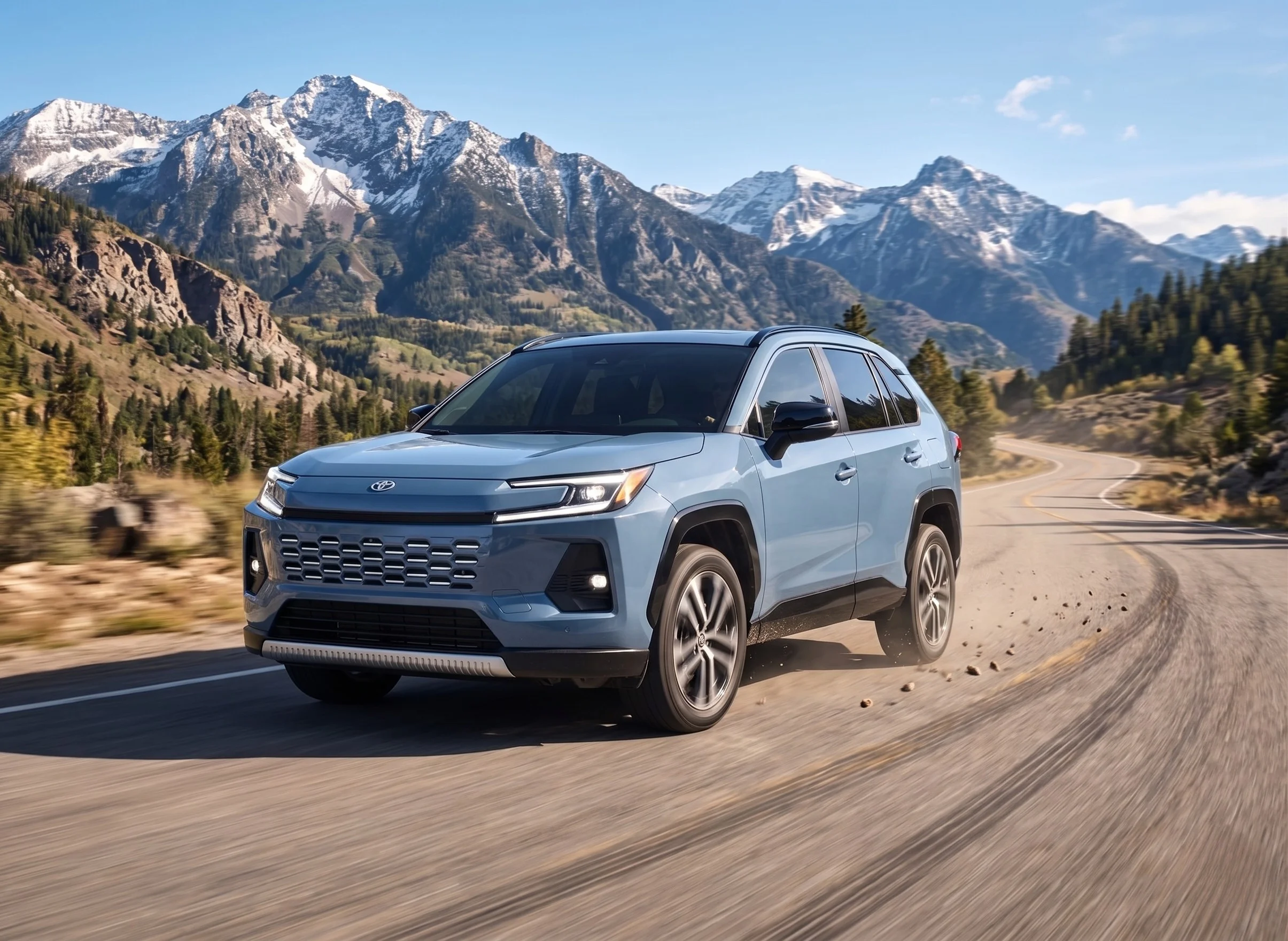
2026 RAV4 Hybrid Efficiency at a Glance
| Most efficient configuration | LE, SE, or XLE Premium with front-wheel drive |
| Best EPA-estimated combined MPG | 43 mpg combined (47 city / 40 hwy) |
| Powertrain | 2.5L hybrid (engine code A25A-FXS) with electric motors |
| Horsepower | 226 hp (FWD) / 236 hp (AWD) |
| Drivetrain | Front-wheel drive or available all-wheel drive |
| Fuel tank | 14.5 gallons |
| Estimated max range | Up to roughly 580 miles |
| Recommended fuel | Regular 87-octane unleaded |
What This Guide Covers
Which 2026 RAV4 Hybrid Gets the Best MPG?
If maximum fuel economy is your priority, the answer is straightforward: choose front-wheel drive. The LE, SE, and XLE Premium trims with FWD top the lineup at 47 city / 40 hwy / 43 combined mpg — the highest ratings available without stepping up to the plug-in. Add all-wheel drive and you trade a little efficiency for traction, but the penalty is small. The rugged Woodland sits at the bottom of the range at 41 / 35 / 38, which is still efficient for a trim built with all-terrain capability in mind.
Here is the full EPA-estimated breakdown by trim and drivetrain:
| Trim | Drivetrain | City | Hwy | Combined |
|---|---|---|---|---|
| LE | FWD | 47 | 40 | 43 |
| LE | AWD | 46 | 39 | 42 |
| SE | FWD | 47 | 40 | 43 |
| SE | AWD | 46 | 39 | 42 |
| XLE Premium | FWD | 47 | 40 | 43 |
| XLE Premium | AWD | 45 | 38 | 41 |
| XSE | AWD | 43 | 37 | 41 |
| Limited | AWD | 43 | 37 | 41 |
| Woodland | AWD | 41 | 35 | 38 |
LE, SE, and XLE Premium come with front-wheel drive standard and all-wheel drive available; Woodland, XSE, and Limited are AWD-standard. Every trim runs on regular unleaded gasoline.
EPA-estimated fuel economy figures are for comparison purposes only. Your actual mileage will vary depending on driving conditions, how you drive and maintain your vehicle, battery age/condition, and other factors.
The practical takeaway: most of the lineup lands between 41 and 43 mpg combined, so even the sportier XSE and Limited stay efficient. Pick FWD if you want the absolute best numbers, and AWD if all-weather traction is worth roughly one mpg.
Does All-Wheel Drive Hurt Your Fuel Economy?
It is the most common efficiency question we hear — and the good news is that the hit is minimal. The 2026 RAV4 Hybrid's AWD system is electronic and on-demand, which works very differently from the mechanical AWD in traditional SUVs. Instead of a heavy driveshaft running the length of the vehicle, Toyota uses a dedicated rear electric motor — rated at 40 kW — to power the back wheels only when extra grip is needed.
Because there is no physical link between the front and rear axles, friction losses are greatly reduced, and the vehicle behaves like a front-wheel-drive crossover most of the time to conserve fuel. That is why the SE with AWD dips only to 46 city / 39 hwy versus 47 / 40 for the front-drive version — a one-mpg trade for genuine all-weather confidence. As a bonus, having motors on both axles lets the RAV4 Hybrid recapture braking energy from all four wheels and reuse it on the next acceleration.
Why the RAV4 Hybrid Is So Efficient
The numbers come from Toyota's fifth-generation hybrid system. Its 2.5L inline-four (engine code A25A-FXS) is tuned specifically for hybrid duty, using high-speed Atkinson-cycle combustion to wring maximum work from every drop of fuel. It pairs with two electric motor-generators — MG1 and MG2 — through a planetary-type continuously variable transmission. MG1 acts mainly as a generator to charge the 248-volt lithium-ion battery, while MG2 sends torque to the wheels. For a wider look at the brand's electrified options, see Toyota's hybrid and electric models.
Two things make this so frugal in everyday driving. First, the electric motors carry the load during low-speed maneuvers and frequent stops, which is exactly why city ratings are so high — the gasoline engine often is not running at all in slow traffic. Second, the planetary CVT lets the engine stay in its most efficient RPM range regardless of vehicle speed, rather than cycling through fixed gears. Add regenerative braking that captures energy during deceleration, and the result is strong mileage without sacrificing power — FWD models still make 226 net combined horsepower, and AWD models step up to 236.
Real-World Range and How to Maximize Your MPG
With a 14.5-gallon fuel tank and most trims rated above 40 mpg combined, the 2026 RAV4 Hybrid delivers exceptional range — under ideal conditions, up to roughly 580 miles on a single tank of regular 87-octane gasoline. For drivers across the San Fernando Valley, that means far fewer stops at the pump.
Local conditions work in your favor here. North Hollywood's mild climate avoids the steeper efficiency losses hybrids can see in extreme cold; the most common local drag on MPG is heavy air-conditioning use during summer heat waves, which draws on the hybrid battery. A few habits help you meet or beat the EPA estimates:
- Watch the hybrid system indicator on the standard 12.3-inch digital gauge cluster — it shows exactly when the gasoline engine is about to engage, helping you stay in Eco mode.
- Accelerate gently. Smooth inputs keep the vehicle in electric mode longer.
- Use the "B" range on long descents to maximize regenerative braking and recover more energy.
Common Questions About RAV4 Hybrid Fuel Economy
Does the 2026 RAV4 Hybrid require a special charging station at home?
No — the RAV4 Hybrid is a self-charging hybrid, not a plug-in. It recharges its battery through the gasoline engine and regenerative braking as you drive, so you never have to plug it in.
What kind of gasoline should I use for the best MPG?
The RAV4 Hybrid is optimized for regular 87-octane unleaded. Premium fuel is not required and generally will not improve efficiency or performance for this engine.
Is maintenance on a hybrid more expensive than on a standard gas car?
Generally, no. Routine maintenance like oil changes and tire rotations follows Toyota's standard service schedule, and because the electric motor handles much of the initial braking, many owners find their brake pads last significantly longer.
Can the RAV4 Hybrid still tow a trailer or boat?
Yes. When properly equipped with all-wheel drive, the 2026 RAV4 Hybrid is rated to tow up to 3,500 lbs — plenty for a small utility trailer, a pair of jet skis, or a light pop-up camper. Front-wheel-drive models and the LE grade are rated at 1,750 lbs.
Does the hybrid battery take up cargo space in the back?
No. Toyota packages the hybrid battery under the rear seats, so you keep about 37.8 cubic feet of cargo space behind the second row.
See the 2026 RAV4 Hybrid at North Hollywood Toyota
Want to put these efficiency numbers to the test? Our team can walk you through how the drive modes — Eco, Sport, and EV Mode — change the vehicle's fuel consumption, whether you are considering the efficiency-leading LE or the feature-packed Limited. You can also explore more hybrid and electric Toyotas in North Hollywood.
Visit our showroom on Lankershim Blvd to browse our current 2026 RAV4 Hybrid inventory and find the trim that fits your driving. To schedule a test drive, reach us at (818) 369-3922 or contact our team online.