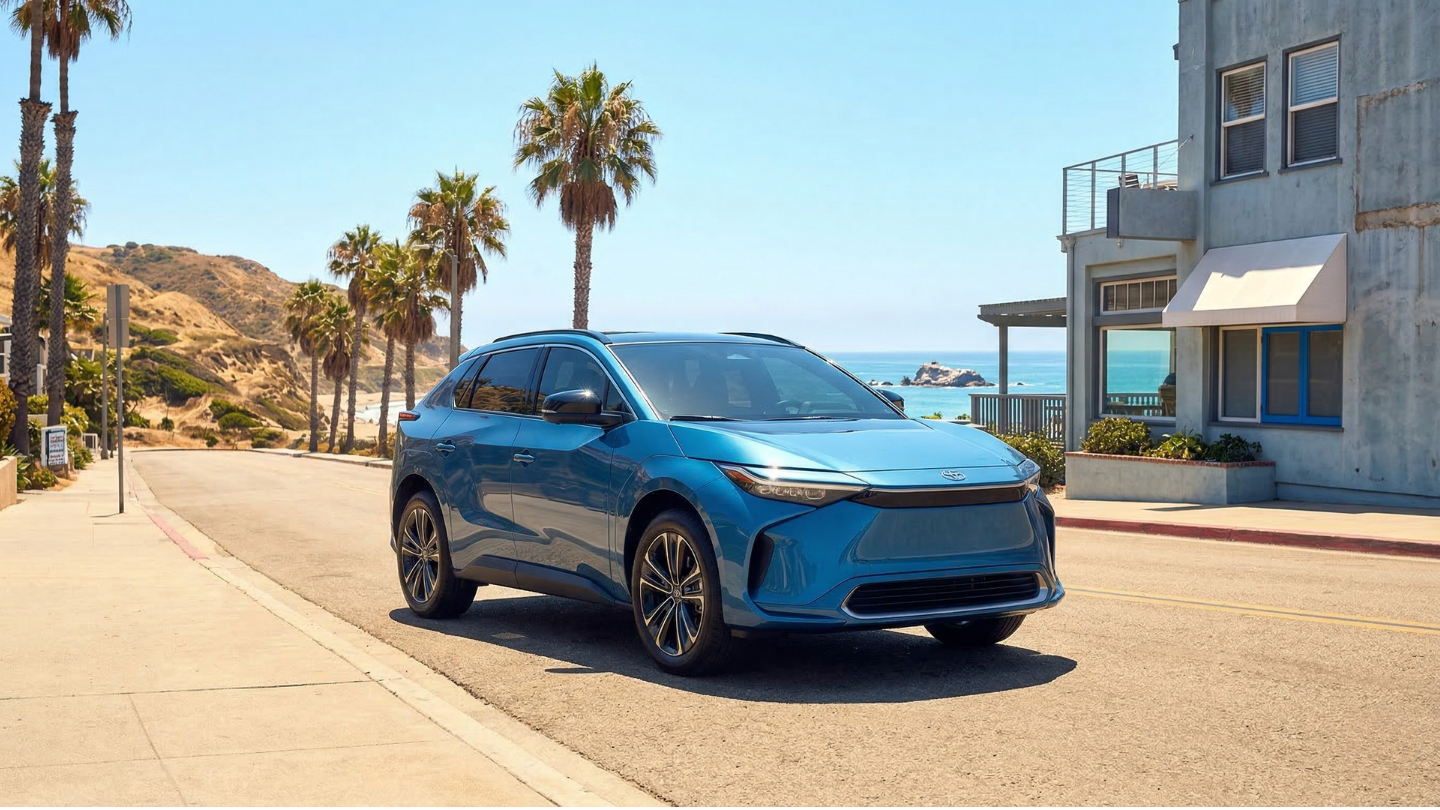
What Happens to Your EV Battery in Hot LA Summers?
If you drive a 2026 Toyota bZ in the Los Angeles area, you already know that summer heat is part of daily life. What you might not realize is how those triple-digit temperatures affect the lithium-ion battery under your feet — and what you can do to keep it performing at its best for years to come.
Here’s the good news: Toyota engineered the 2026 bZ with Southern California heat in mind. But understanding the science behind heat and battery health gives you a real advantage. Let’s break it down.
How Heat Affects Your EV Battery
The science behind summer heat and lithium-ion battery degradation
Lithium-ion batteries — including the 57.7 kWh and 74.7 kWh packs available in the 2026 Toyota bZ — perform best within a temperature window of roughly 60°F to 95°F. That’s a comfortable range for most of the year, but North Hollywood summers routinely push well past 90°F, and parked vehicles baking in direct sunlight can see internal temperatures climb far higher.
When temperatures exceed that optimal range, the chemical reactions inside battery cells accelerate in ways that gradually wear down capacity. Heat breaks down protective layers within the cells, consumes active lithium, and increases internal resistance. Over time, this translates to reduced driving range and slower charging speeds.
📊 What the Data Shows
A 2025 Geotab study analyzing over 22,700 electric vehicles found that batteries operating in hot climates degrade roughly 0.4% faster per year than those in milder environments. Compounded over several years, that difference can meaningfully impact range and battery health.
High temperatures also affect charging. When the battery is already hot, the battery management system may limit charging speed to prevent overheating. Frequent use of DC fast chargers during peak afternoon heat compounds this stress — research consistently shows that fast charging in hot conditions accelerates capacity loss compared to slower charging in cooler temperatures.
How the 2026 Toyota bZ Fights the Heat
Built-in thermal engineering designed for climates like ours
Toyota didn’t leave battery protection to chance. The 2026 bZ comes equipped with a sophisticated thermal management system built to handle exactly the kind of heat North Hollywood dishes out every summer.
The system uses a liquid cooling loop with a water-to-water heat exchanger that actively circulates coolant through the battery pack, pulling heat away from the cells and dissipating it efficiently. This is significantly more effective than air-cooled systems found in some competing EVs — liquid cooling maintains more consistent temperatures across the entire battery pack, preventing the hotspots that accelerate uneven degradation.
| 2026 bZ Thermal Feature | What It Does |
|---|---|
| Liquid Cooling System | Circulates coolant through the battery pack to actively dissipate heat and prevent hotspots |
| Battery Preconditioning | Automatically adjusts battery temperature before charging for optimal efficiency and longevity |
| Heat Pump | Manages cabin and battery climate more efficiently, preserving driving range |
| NACS Charging Port | Native access to Tesla Supercharger network with preconditioning support |
| 8-Year / 100,000-Mile Warranty | Guarantees minimum 70% original battery capacity |
These features work together to keep your battery within its optimal temperature range — even during the most intense summer heat. Toyota’s 8-year, 100,000-mile battery warranty, which guarantees a minimum of 70% original capacity, is a concrete commitment that reflects confidence in the bZ’s durability in demanding climates like Southern California.
Practical Tips to Protect Your 2026 Toyota bZ Battery This Summer
Smart habits for North Hollywood and San Fernando Valley EV owners
Park Smart
Direct sunlight is your battery’s worst enemy when the car is sitting idle. Parking in shaded areas, covered garages, or structures can reduce interior and battery temperatures significantly compared to an unshaded lot. If covered parking isn’t available, a reflective windshield sunshade helps keep overall vehicle temperatures down, reducing the workload on the thermal management system.
Charge at Night
Nighttime charging is one of the simplest and most effective ways to extend battery life in a hot climate. LA overnight temperatures drop considerably compared to midday peaks, which means less thermal stress on the battery during charging. The cooler environment lets the thermal management system work more efficiently and allows the battery to accept charge at optimal rates. There’s a financial benefit too — time-of-use electricity rates from LA-area utilities are typically lowest during off-peak nighttime hours. The 2026 bZ’s programmable charge scheduling makes this easy to automate.
Keep Your Charge Between 20% and 80%
Batteries experience the most chemical stress at the extremes — near full and near empty. For daily driving, keeping your state of charge between roughly 20% and 80% reduces voltage stress and heat generation during charge cycles. The 2026 bZ’s battery management software includes built-in buffers, but staying within this moderate range during hot weather gives your battery additional protection. Charging to 100% is perfectly fine before a long trip — just avoid leaving the car sitting at full charge in the heat for extended periods.
💡 Pro Tip: Use Preconditioning Before You Drive
The 2026 bZ’s preconditioning feature can cool both the cabin and battery while the vehicle is still plugged in, using grid power instead of battery energy. Activate it before your morning commute to start with an already-cooled battery and cabin — preserving range and reducing thermal stress.
Be Strategic with Fast Charging
The 2026 bZ supports DC fast charging from 10% to 80% in approximately 30 minutes under ideal conditions, and the NACS port gives you native access to the Tesla Supercharger network. However, fast charging during the hottest part of the day generates additional heat stress. When possible, save DC fast charging sessions for cooler morning or evening hours and rely on Level 2 home charging for daily needs.
What This Means for Your Driving Range
Day-to-day range impact and how to manage it
Heat doesn’t just affect long-term battery health — it impacts your day-to-day range as well. When temperatures climb, the battery’s internal resistance increases and the thermal management system draws additional power to keep temperatures in check. Air conditioning demand adds to the energy load.
The 2026 Toyota bZ delivers up to 314 miles of EPA-estimated range on the XLE FWD Plus trim. In peak summer heat, expect some reduction from that estimate as the vehicle manages thermal demands. The degree of impact depends on driving style, AC usage, and how hot it gets on any given day — but the bZ’s efficient thermal management and heat pump technology help minimize the loss compared to EVs without these features.
Smooth driving habits, moderate use of climate controls, and keeping tires properly inflated all contribute to preserving range in hot conditions.
Ready to Experience the 2026 Toyota bZ?
Summer heat is a reality of driving an EV in Los Angeles — but it doesn’t have to be a liability. The 2026 Toyota bZ was built with the tools to handle it. Discover it for yourself at North Hollywood Toyota.
Learn more: How Long Does an EV Last? | Hybrid Maintenance Schedule
Visit us at 4606 Lankershim Blvd, North Hollywood, CA 91602