Hybrid Maintenance in LA Heat and Traffic: What to Expect at 30k, 60k, and 100k Miles
If you drive a Toyota hybrid in the San Fernando Valley, your maintenance schedule isn't just about mileage — it's about conditions. North Hollywood summers regularly push past 90°F, heat waves in Burbank have topped 114°F, and stop-and-go traffic on Lankershim, the 101, and the 170 puts constant cycling demands on your hybrid battery. That's a meaningfully different operating environment than what Toyota engineers in a mild-climate test cycle. Here's what to expect — and what to prioritize — at each major service milestone.
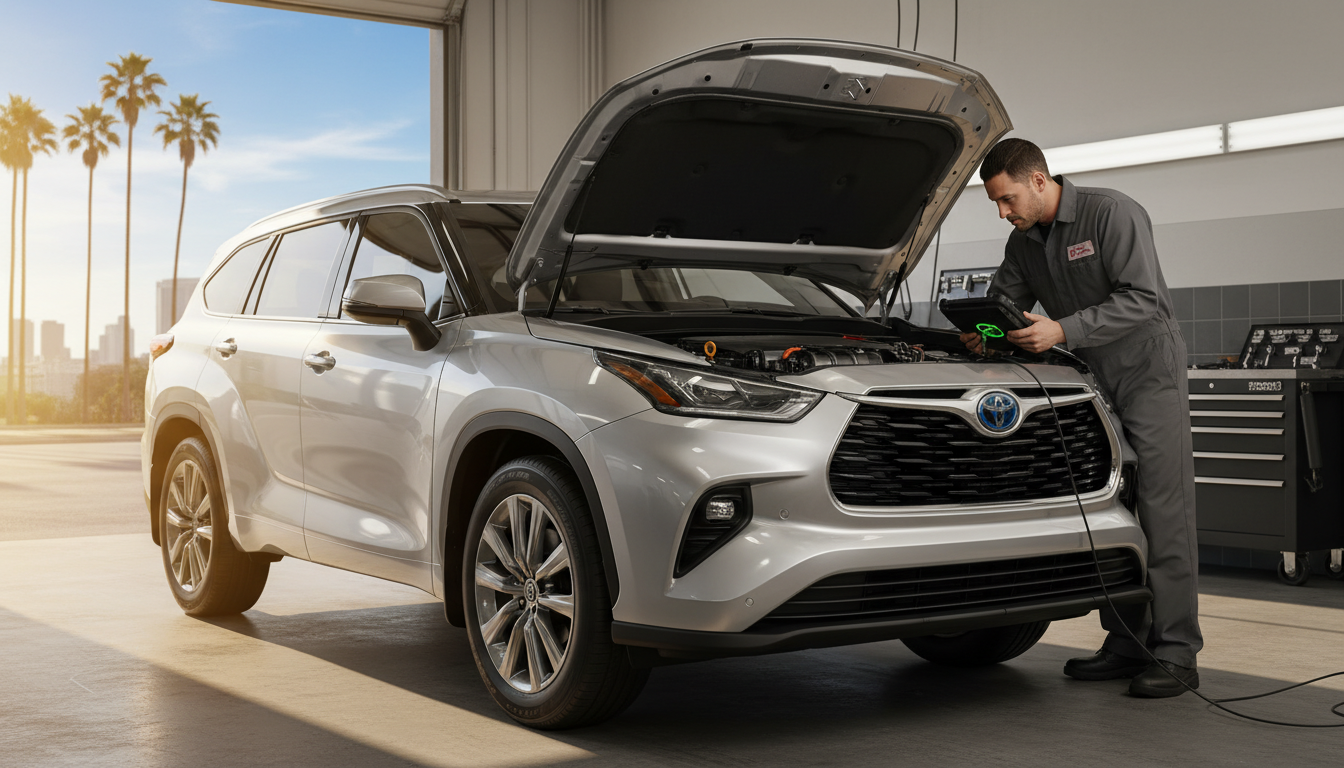
Why Hybrid Maintenance Differs From Standard Service
Toyota hybrids blend a gasoline engine with an electric motor and a high-voltage battery pack, and those systems interact in ways that create unique wear patterns. Regenerative braking reduces brake pad wear but introduces electronic calibration needs. The hybrid battery and its cooling system require periodic assessment that a standard oil-change service won't address. And software-driven control units need updates to optimize how the engine and motor divide the workload.
In the San Fernando Valley, two additional factors amplify every one of these needs: sustained heat and urban stop-and-go cycling. A hybrid battery operating in 100°F+ ambient temperatures is being pushed harder than one in San Francisco or Seattle. The cooling system has to work continuously. Fluid degradation accelerates. These aren't hypothetical risks — they're predictable service needs that belong on your calendar alongside every oil change.
The 30,000-Mile Service: Foundational Checks
The first major hybrid checkpoint — and your best early-warning window.
The 30k service establishes your hybrid's baseline health. Beyond the standard oil and filter change, tire rotation, and air filter replacements, this visit should include:
Battery Health Assessment
Diagnostic testing of charge capacity, cell balance, and cooling system function. At 30k, you're catching early indicators, not replacing anything. This is the check that tells you whether the battery is aging normally or showing early thermal stress.
Cooling System Inspection
Both the engine and hybrid battery rely on coolant to stay within safe operating ranges. Hose condition, coolant level, and radiator function should all be verified. In North Hollywood, this isn't a box-ticking exercise — it's a heat-stress audit.
Inverter Cooling Check
The inverter converts battery power for the electric motor and generates significant heat doing it. Its dedicated cooling circuit should be confirmed functioning at this interval.
Brake System Inspection
Regenerative braking reduces pad wear in hybrids, but it doesn't eliminate it. Pads, rotors, and brake fluid should all be evaluated. Brake fluid contaminated with moisture can degrade braking feel and hydraulic response — a flush may be warranted depending on condition.
High-Voltage Wiring Inspection
Connections and cables in the high-voltage system should be examined for any signs of wear, corrosion, or heat damage.
⚠ Don't Skip the 30k Window
Skipping the 30k service doesn't mean nothing fails at 31,000 miles. It means you lose the early warning window — the point where minor battery cooling inefficiency is a $0 service note rather than a $2,000 repair.
The 60,000-Mile Service: Mid-Life Maintenance
Inspections become replacements. The battery gets its first serious evaluation.
At 60k, the service scope expands. Components that were inspected at 30k now get replaced or flushed, and the battery receives a more detailed evaluation.
Fluid Replacements
Engine coolant and transmission fluid degrade under heat cycling. Both are typically due for flushing and replacement at this interval. For Valley drivers, coolant degradation runs faster than in cooler climates — don't treat the manufacturer's recommended interval as a maximum in this environment.
Battery Diagnostics
By 60k, the battery has accumulated meaningful charge-discharge history. Technicians run specialized scans evaluating charge capacity, voltage consistency across cells, and thermal regulation performance. In a hot climate, this is where heat-related degradation first becomes measurable — the test either confirms the battery is aging well or surfaces early intervention needs.
Drive Belt Assessment
Serpentine and accessory belts endure heat, tension, and constant flexing. At 60k they should be inspected for cracking or glazing. A worn belt failure doesn't give warning — it strands you.
Inverter and Power Control Unit Inspection
Electrical connections, error codes, and cooling circuit function for the power electronics should be verified at this interval.
Suspension Check
Shocks, struts, and bushings affect ride quality, handling, and tire wear. Worth a thorough look at 60k, especially given the added weight of hybrid battery packs and the acceleration-heavy demands of Valley traffic patterns.
The 100,000-Mile Service: Comprehensive System Review
The most extensive interval in your hybrid's life. Everything gets examined.
The 100k service is the most extensive interval in your hybrid's life. Everything gets looked at, and some things that were inspected at earlier intervals now get replaced.
Hybrid Battery Full Diagnostic
By 100k, the battery's long-term health is measurable with precision. Technicians use advanced diagnostic equipment to assess state of charge, voltage consistency, and individual cell condition. If degradation is detected, reconditioning the battery modules may be appropriate; full replacement is possible but less common on well-maintained Toyota hybrids. The battery's health at 100k directly determines fuel efficiency and electric motor performance going forward.
Spark Plugs
Despite hybrid engines running fewer hours than a comparable non-hybrid, spark plugs are due at 100k. Fresh plugs ensure clean combustion, proper fuel economy, and reduced emissions.
Full Coolant System Flush
Old coolant loses its corrosion inhibitors and heat-transfer efficiency over time. A 100k flush removes contaminants and recharges the system's ability to manage thermal load — essential for a battery that still needs active cooling at highway speeds in August heat.
Brakes
Pads, rotors, and brake fluid all receive thorough evaluation. Fluid is flushed. Rotor surfaces are inspected for warping or scoring. If regenerative braking has been doing most of the work, pad wear may be light — but fluid condition and rotor integrity still matter.
Belts and Hoses
Serpentine belt and all cooling system hoses should be replaced if any signs of wear are present. The risk of a heat-cracked hose or belt failure at 100k is real enough that proactive replacement often makes economic sense.
Suspension and Steering
Ball joints, tie rods, shocks, and struts receive a full inspection. Wheel alignment is checked and adjusted. Worn suspension at this mileage affects tire life, fuel economy, and safety.
Software Updates
Toyota continuously refines hybrid powertrain control algorithms. At 100k, a full software diagnostic ensures your hybrid's energy management is running on current calibrations — particularly relevant for battery management in extreme temperature conditions.
The LA Heat Factor: What Valley Drivers Need to Know
North Hollywood isn't a mild-climate test environment. Maintain accordingly.
Toyota hybrid batteries — primarily nickel-metal hydride chemistry in standard HEVs, lithium-ion in plug-in hybrids like the Prius Prime — are engineered to operate within a specific thermal range. When ambient temperatures climb into the 90s and 100s, the battery's cooling system is working at or near capacity just to maintain safe operating conditions. That's before accounting for regenerative braking cycles and electric motor operation, both of which generate additional heat.
The consequence of sustained heat stress isn't usually sudden failure — it's gradual capacity loss. The battery holds less charge. The gasoline engine runs more to compensate. Fuel economy declines. In stop-and-go traffic on the 101 during a Valley heat wave, you're stacking thermal inputs simultaneously: ambient heat, engine heat, braking cycles, and air conditioning load drawing on the battery during engine-off idle phases.
💡 What This Means for Your Service Schedule
Toyota hybrids have a proven track record in Southern California — but the standard maintenance schedule is a minimum, not a ceiling. Cooling system inspections should be thorough at every interval. Fluid changes shouldn't be deferred. Battery diagnostics shouldn't wait for a warning light.
For current Toyota hybrid models (2020 model year and later), the hybrid battery is backed by a 10-year/150,000-mile warranty. The best way to make sure that warranty remains relevant is to maintain the cooling system that protects it.
Schedule Your Hybrid Service at North Hollywood Toyota
Our service team works on Toyota hybrids every day — in the same heat, the same traffic, and the same conditions you're driving through. Toyota-certified technicians, genuine Toyota parts, and manufacturer-approved diagnostic tools are the standard here, not the exception.
Visit us at 4606 Lankershim Blvd, North Hollywood, CA 91602