2026 Toyota Prius vs. 2026 Hyundai Ioniq 6
2026 Toyota Prius vs. 2026 Hyundai Ioniq 6: Hybrid Efficiency Meets Electric Innovation
Choosing between the 2026 Toyota Prius and the 2026 Hyundai Ioniq 6 comes down to a single question: do you want the freedom of a 50-plus-mpg hybrid that never needs a charger, or the all-electric range and performance of a dedicated EV? Both are sleek, efficient, tech-forward sedans — but they solve the efficiency problem in fundamentally different ways. Here is an honest, side-by-side look to help drivers in North Hollywood, Burbank, and Studio City decide.
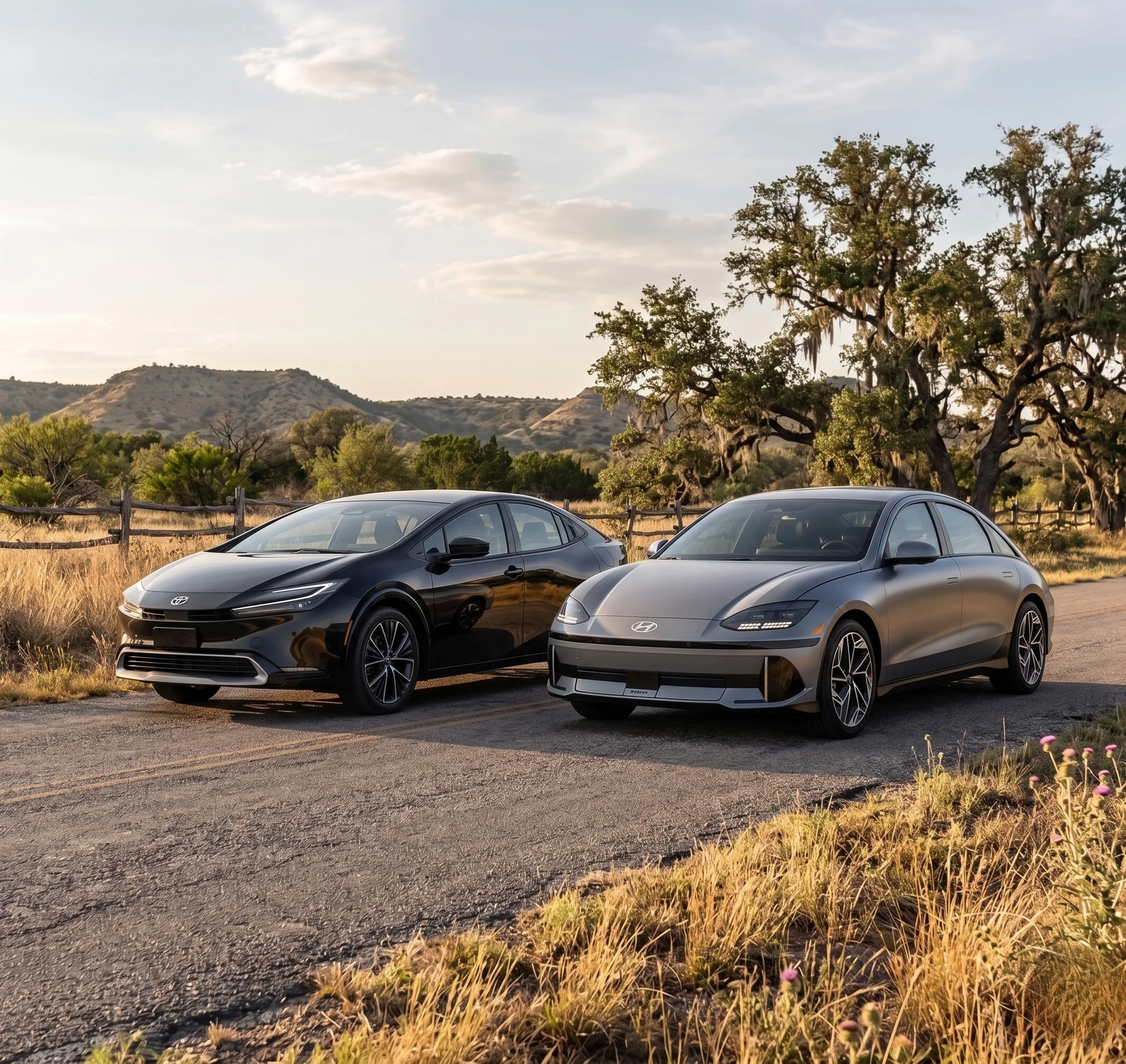
Powertrain & Performance: Two Roads to Efficiency
The 2026 Toyota Prius pairs a 2.0L four-cylinder engine with the fifth-generation Toyota Hybrid System (THS) for a net 194 horsepower with front-wheel drive, or 196 horsepower with available electronic on-demand all-wheel drive (AWD). AWD models reach 0–60 mph in about 7.0 seconds. Every Prius trim uses an electronically controlled continuously variable transmission (CVT), and front-wheel drive is standard across the lineup — AWD is an available upgrade on any trim.
The 2026 Hyundai Ioniq 6 is a dedicated electric vehicle built on Hyundai's 800V E-GMP architecture. Depending on trim and battery, it produces from 149 horsepower (SE Standard Range, RWD) up to 320 horsepower (dual-motor AWD), with a single-speed transmission. A separate high-performance Ioniq 6 N joins the lineup with up to 641 horsepower for performance-focused shoppers.
The takeaway: the Prius delivers efficient, no-charging-required power that is ideal for drivers who cannot always plug in, while the Ioniq 6 offers stronger straight-line performance and instant electric torque for those ready to go fully electric.
Engine & Drivetrain at a Glance
| Specification | 2026 Toyota Prius | 2026 Hyundai Ioniq 6 |
|---|---|---|
| Powertrain | 2.0L 4-cyl hybrid (THS) | Single- or dual-motor electric |
| Horsepower | 194 (FWD) / 196 (AWD) | 149–320 (by trim) |
| Transmission | CVT (all trims) | Single-speed |
| Drivetrain | FWD standard; AWD available | RWD standard; AWD available |
| Fuel Type | Hybrid (regular unleaded) | Electric |
Full Trim Lineups
Both sedans offer a clear ladder of trims. The 2026 Toyota Prius starts at a TSRP of $28,550 for the LE and keeps things simple with four hybrid grades. The 2026 Hyundai Ioniq 6 starts at an MSRP of $37,850 for the SE Standard Range, spanning an efficiency-focused range topped by the track-ready Ioniq 6 N.
2026 Toyota Prius Trims
| Trim | Drivetrain | Highlights |
|---|---|---|
| LE | FWD (AWD available) | 8-in touchscreen, Toyota Safety Sense 3.0, up to 57 EPA-est. combined MPG |
| XLE | FWD (AWD available) | SofTex-trimmed seats, heated front seats, wireless charging, 19-in wheels |
| Nightshade | FWD (AWD available) | Blacked-out exterior accents, 19-in black alloy wheels, unique badging |
| Limited | FWD (AWD available) | Standard 12.3-in screen, JBL premium audio, fixed glass roof, power liftgate |
2026 Hyundai Ioniq 6 Trims
| Trim | Power / Drivetrain | Highlights |
|---|---|---|
| SE Standard Range | 149 hp, RWD | Dual 12.3-in displays, up to 240 mi range, blind-spot monitoring |
| SE | 225 hp RWD / 320 hp AWD | Larger battery, heated front seats, up to 342 mi range (RWD) |
| SEL | 225 hp RWD / 320 hp AWD | Synthetic leather, wireless charging, added driver assistance |
| Limited | 225 hp RWD / 320 hp AWD | Ventilated seats, sunroof, Bose audio, surround-view camera |
| Ioniq 6 N | Up to 641 hp, AWD | Track-focused performance, 0–60 in ~3.2 sec, 84-kWh battery, NACS port |
Starting prices shown are base figures. Toyota TSRP excludes the manufacturer's destination/handling charge, taxes, title, license, and dealer fees; AWD is an available upgrade on all Prius trims. The dealer sets the final price. Hyundai MSRP shown excludes freight, tax, title, and license fees. Pricing and availability subject to change — contact us for current figures.
Efficiency & Range: MPG vs. Miles
This is the heart of the comparison. The Prius measures efficiency in EPA-estimated miles per gallon; the Ioniq 6 measures it in EPA-estimated electric range and MPGe.
The most efficient Prius — the LE with front-wheel drive — earns an EPA-estimated 57 city / 56 highway / 57 combined MPG. The XLE, Nightshade, and Limited trims (FWD) are EPA-estimated at 52/52/52 MPG, and their AWD versions at 49/50/49 MPG. The LE AWD lands at 53/54/54 MPG.
The Ioniq 6 offers an EPA-estimated driving range of roughly 240 to 342 miles depending on trim, battery, and drivetrain — the long-range SE rear-drive configuration reaches the top of that range. Paired with 800V ultra-fast charging, it can replenish from 10% to 80% in as little as 18 minutes at a 350 kW DC fast charger.
EPA-Estimated Fuel Economy & Range
| Specification | 2026 Toyota Prius | 2026 Hyundai Ioniq 6 |
|---|---|---|
| Fuel Type | Hybrid (regular unleaded) | Electric |
| EPA-Est. City MPG | 49–57 | Not applicable (EV) |
| EPA-Est. Highway MPG | 50–56 | Not applicable (EV) |
| EPA-Est. Combined MPG | 49–57 | Not applicable (EV) |
| EPA-Est. Electric Range | Not applicable | Up to 342 miles |
| Fast Charging (10–80%) | Not applicable | As little as 18 min (350 kW) |
EPA-estimated figures shown for comparison purposes only. Actual mileage and range will vary with driving conditions, habits, vehicle condition, and other factors.
Design, Dimensions & Everyday Usability
Both sedans are built around aerodynamic efficiency, but they wear it differently. The Prius keeps a compact, urban-friendly footprint, while the Ioniq 6 is a longer, wider "electrified streamliner" with one of the lowest drag coefficients in the segment.
The Prius measures 181.1 inches long, 70.2 inches wide, and 58.7 inches tall — easy to park and maneuver on North Hollywood streets. The Ioniq 6 is notably larger at 191.1 inches long, 74.0 inches wide, and 58.9 inches tall, with a 116.1-inch wheelbase that opens up rear legroom. Both seat five.
Dimensions & Capacity
| Specification | 2026 Toyota Prius | 2026 Hyundai Ioniq 6 |
|---|---|---|
| Seating Capacity | 5 | 5 |
| Length | 181.1 in | 191.1 in |
| Width | 70.2 in | 74.0 in |
| Height | 58.7 in | 58.9 in |
| Wheelbase | Not listed | 116.1 in |
Technology & Infotainment
Both vehicles are well-equipped, with available large-screen layouts and wireless smartphone integration standard. The Prius starts with an 8-inch touchscreen on the LE and XLE, with an available 12.3-inch Toyota Audio Multimedia screen on the XLE (standard on Limited) and a 7-inch digital driver display. The Ioniq 6 comes standard with dual 12.3-inch displays across the lineup, standard wireless charging, and an available Bose premium audio system on the Limited.
Technology Comparison
| Feature | 2026 Toyota Prius | 2026 Hyundai Ioniq 6 |
|---|---|---|
| Center Touchscreen | 8-in standard; 12.3-in available/standard (Limited) | 12.3-in standard |
| Digital Driver Display | 7-in standard | 12.3-in standard |
| Wireless Apple CarPlay / Android Auto | Standard | Standard |
| Wireless Charging | Available (XLE, Limited) | Standard |
| Premium Audio | JBL (standard on Limited) | Bose (available on Limited) |
Safety
Both sedans bring strong safety credentials. The 2026 Toyota Prius is an IIHS Top Safety Pick+ — the Institute's highest honor — and comes standard with the Toyota Safety Sense 3.0 suite, including Blind Spot Monitor and Lane Departure Alert. The Ioniq 6 includes Hyundai SmartSense as standard, with blind-spot monitoring, lane keeping assist, and standard rear automatic braking (an available feature on the Prius).
Safety & Driver Assistance
| Feature | 2026 Toyota Prius | 2026 Hyundai Ioniq 6 |
|---|---|---|
| IIHS Rating | Top Safety Pick+ | Top Safety Pick (2025 reference) |
| Blind Spot Monitor | Standard | Standard |
| Lane Departure / Keeping | Standard | Standard |
| Rear Automatic Braking | Available | Standard |
Pricing, Warranty & Long-Term Value
The Prius makes electrified driving accessible, with a starting TSRP of $28,550 for the LE. The Ioniq 6 starts higher, reflecting its all-electric drivetrain and larger battery. On warranty, the two diverge in ways that matter for electrified vehicles — particularly battery coverage.
Warranty Coverage
| Coverage | 2026 Toyota Prius | 2026 Hyundai Ioniq 6 |
|---|---|---|
| Basic | 3 yr / 36,000 mi | 5 yr / 60,000 mi |
| Powertrain | 5 yr / 60,000 mi | 10 yr / 100,000 mi |
| Hybrid / EV Battery | 10 yr / 150,000 mi | 10 yr / 100,000 mi |
| Roadside Assistance | 2 yr / unlimited mi | 5 yr / unlimited mi |
The Prius also includes 8-year/100,000-mile hybrid-component coverage and 2 years of ToyotaCare scheduled maintenance. Warranty terms shown are summaries; see dealer for complete coverage details, limitations, and exclusions.
The Verdict: Which Sedan Is Right for You?
The 2026 Toyota Prius is the stronger choice for drivers who want exceptional efficiency without changing how they refuel — over 50 mpg, a lower starting price, all-weather AWD availability, an IIHS Top Safety Pick+ rating, and Toyota's long hybrid-battery coverage. It is the practical, proven path to electrified driving. The Ioniq 6 rewards drivers ready to go fully electric with longer all-electric range, quicker acceleration, and ultra-fast charging.
For most North Hollywood and Burbank-area shoppers who want efficiency they can rely on from day one, the Prius delivers the best balance of value, convenience, and peace of mind.
Frequently Asked Questions
Is the Toyota Prius a hybrid or an electric car?
The 2026 Toyota Prius is a hybrid — it pairs a gas engine with an electric motor and never needs to be plugged in. The Hyundai Ioniq 6, by contrast, is a fully electric vehicle that you charge rather than refuel. If you want electrified efficiency without ever stopping at a charging station, the Prius is the hybrid option.
Which is more efficient, the Prius or the Ioniq 6?
They measure efficiency differently. The Prius earns up to an EPA-estimated 57 combined MPG, while the all-electric Ioniq 6 delivers up to 342 miles of EPA-estimated range on a charge. The Prius wins on never needing to charge; the Ioniq 6 wins on eliminating gas entirely.
Does the 2026 Toyota Prius come with all-wheel drive?
Yes. Front-wheel drive is standard on every Prius trim, and electronic on-demand all-wheel drive (AWD) is available as an upgrade on all four trims — LE, XLE, Nightshade, and Limited.
How much does the 2026 Toyota Prius cost compared to the Ioniq 6?
The 2026 Prius starts at a TSRP of $28,550 for the LE, while the Ioniq 6 starts at $37,850 for the SE Standard Range — a notable difference that makes the Prius the more budget-friendly entry into electrified driving. Final pricing varies; contact North Hollywood Toyota for current figures.
Do I have to charge a Toyota Prius?
No. The standard Prius hybrid charges its own battery as you drive and brake, so you only ever add gas. If you want the option to plug in for short all-electric trips, Toyota also offers the Prius Plug-in Hybrid, which you can explore separately.
Which has the better battery warranty?
The Prius hybrid battery is covered for 10 years / 150,000 miles, while the Ioniq 6's EV battery is covered for 10 years / 100,000 miles. Toyota's longer mileage coverage is a meaningful advantage for drivers planning to keep their vehicle for many years.
Find Your Next Prius at North Hollywood Toyota
Visit us at 4606 Lankershim Blvd, North Hollywood, CA 91602