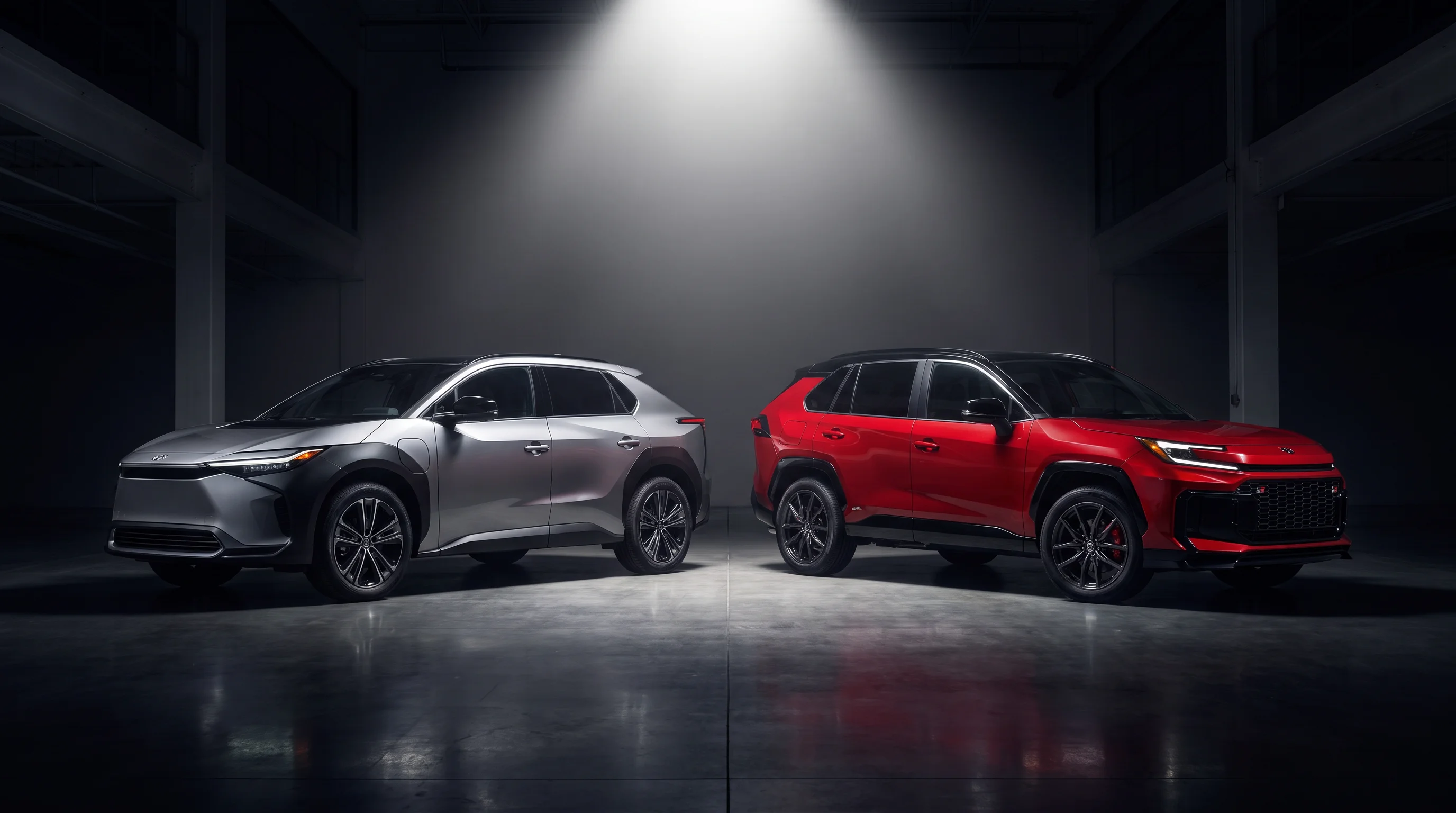
2026 Toyota bZ vs 2026 RAV4 Plug-in Hybrid: Range, Charging, and Which One Fits Your Drive
2026 Toyota bZ vs 2026 RAV4 Plug-in Hybrid: Range, Charging, and Which One Fits Your Drive
Both of these Toyotas plug in. Only one of them has to. The bZ is fully electric with up to 314 miles of EPA-estimated range; the RAV4 Plug-in Hybrid runs about 54 miles on electricity, then keeps going as a hybrid. The choice isn't which is better — it's which matches how you drive and where you park.
At a Glance
| Specification | 2026 Toyota bZ | 2026 RAV4 Plug-in Hybrid |
|---|---|---|
| Powertrain type | All-electric | Plug-in hybrid |
| Starting price | $36,350 TSRP | $42,950 TSRP |
| Best electric range | 314 mi | 54 mi |
| Maximum output | 338 hp | 324 hp |
| Drivetrain | FWD or AWD | AWD standard |
| Towing | Not rated | Up to 3,500 lbs |
| Lineup | 3 grades / 5 configurations | 4 grades |
Which One Fits You: 2026 Toyota bZ or 2026 RAV4 Plug-in Hybrid?
Two strong vehicles, two different drivers
The Short Answer
| If this is you… | Your vehicle |
|---|---|
| You can charge at home or at work most nights | Toyota bZ |
| Your driving is local and predictable | Toyota bZ |
| You want the lower starting price | Toyota bZ |
| You can't reliably plug in where you park | RAV4 Plug-in Hybrid |
| You take long road trips several times a year | RAV4 Plug-in Hybrid |
| You need to tow | RAV4 Plug-in Hybrid |
| You want the quickest acceleration | Either — both reach 60 mph in about 5 seconds |
The bZ Makes Sense When
- You have a garage, carport, or workplace charging
- Your daily driving stays inside the Valley and the LA basin
- Long trips are rare, and you're comfortable planning a fast-charge stop
- You want to stop buying gasoline entirely
The RAV4 Plug-in Hybrid Makes Sense When
- Charging access is uncertain, shared, or street-parked
- You commute on electricity during the week and drive long distances on weekends
- You tow a trailer, boat, or utility hauler
- You want plug-in efficiency without changing how you plan a trip
Both are on the ground at 4606 Lankershim Blvd.
How Do Prices and Trim Levels Compare?
Five bZ configurations, four RAV4 Plug-in Hybrid grades
2026 Toyota bZ — Three Grades, Five Configurations
| Configuration | TSRP | Battery | Horsepower | EPA-est. Range |
|---|---|---|---|---|
| XLE FWD | $36,350 TSRP | 57.7 kWh | 168 hp | 236 mi |
| XLE Plus FWD | $39,350 TSRP | 74.7 kWh | 221 hp | 314 mi |
| XLE AWD | $41,350 TSRP | 74.7 kWh | 338 hp | 288 mi |
| Limited FWD | $44,750 TSRP | 74.7 kWh | 221 hp | 299 mi |
| Limited AWD | $46,750 TSRP | 74.7 kWh | 338 hp | 278 mi |
Pricing and range ratings published by Toyota at toyota.com/bz. Configuration detail on our 2026 bZ trim levels page.
2026 RAV4 Plug-in Hybrid — Four Grades
| Grade | TSRP | Horsepower | Drivetrain | EPA-est. Electric Range |
|---|---|---|---|---|
| SE | $42,950 TSRP | 324 hp | AWD | 54 mi |
| Woodland | $46,750 TSRP | 324 hp | AWD | 49 mi |
| XSE | $48,650 TSRP | 324 hp | AWD | 52 mi |
| GR SPORT | $49,950 TSRP | 324 hp | AWD | 48 mi |
Pricing and range ratings published by Toyota at toyota.com/rav4pluginhybrid. Grade detail on our RAV4 Plug-in Hybrid grades page.
⚠ Pricing Disclaimer
Total Suggested Retail Price (TSRP) for new vehicles includes manufacturer and distributor options and delivery, processing, and handling fees, which are subject to change at any time. TSRP excludes taxes, title, license, dealer-installed options, accessories, fees and charges. TSRP is not the dealer advertised price. Dealer price will vary. The dealer sets the final price.
What the Pricing Tells You
- The EV is the cheaper entry point. The bZ starts roughly $6,600 below the RAV4 Plug-in Hybrid — the reverse of what most shoppers expect.
- They overlap in the middle. A bZ Limited AWD and a RAV4 Plug-in Hybrid Woodland both land at $46,750 TSRP.
- Power is flat across the RAV4 PHEV lineup. All four grades make 324 hp with standard AWD, so you're buying equipment and range, not performance.
- Power scales on the bZ. 168 hp at the bottom, 338 hp on either AWD configuration.
How Far Does Each One Go on Electricity?
314 miles versus 54 miles — and why that comparison is misleading on its own
Electric Range and Efficiency
| Specification | 2026 Toyota bZ | 2026 RAV4 Plug-in Hybrid |
|---|---|---|
| Best electric range | 314 mi (XLE Plus FWD) | 54 mi (SE) |
| Range by configuration | 236 mi XLE FWD · 278 mi Limited AWD · 288 mi XLE AWD · 299 mi Limited FWD · 314 mi XLE Plus FWD | 48 mi GR SPORT · 49 mi Woodland · 52 mi XSE · 54 mi SE |
| Battery | 57.7 kWh (XLE FWD) · 74.7 kWh (all others) | 22.7 kWh |
| Gas engine | None | 2.5L four-cylinder |
| Hybrid MPG once the battery is depleted | Not applicable | 44/38/41 city/hwy/comb (SE, XSE) · 42/35/38 (Woodland) · 41/34/37 (GR SPORT) |
| When the battery runs out | Recharge required | Continues as a hybrid |
Fuel economy and range figures published by Toyota at Toyota USA Newsroom and toyota.com/bz. More detail in our bZ MPGe and range guide and our RAV4 Plug-in Hybrid features and MPG breakdown.
⚠ Fuel Economy and Range Disclaimer
EPA-estimated fuel economy figures are for comparison purposes only. Your actual mileage will vary depending on driving conditions, how you drive and maintain your vehicle, battery age/condition, and other factors.
What That Means for a Valley Commute
- A 30-mile round trip: both run on electricity alone, every weekday.
- A 60-mile day: the bZ handles it easily; the RAV4 Plug-in Hybrid finishes on gas.
- A drive to Santa Barbara and back: the bZ needs a charging stop; the RAV4 Plug-in Hybrid doesn't.
- A week without plugging in: the bZ loses range it can't replace; the RAV4 Plug-in Hybrid simply operates as a hybrid.
That last line is the whole comparison. The RAV4 Plug-in Hybrid tolerates a bad charging week. The bZ doesn't.
Can You Charge Where You Park?
The question that decides this more than any spec
Charging Hardware by Model
| Specification | 2026 Toyota bZ | RAV4 PHEV SE / GR SPORT | RAV4 PHEV XSE / Woodland |
|---|---|---|---|
| Onboard charger | 11 kW | 7 kW | 11 kW |
| DC fast charging | Yes — up to 150 kW | No | Yes |
| 10–80% on DC fast | About 30 min | Not available | About 30 min |
| Level 2 (240V) charging | About 7 hrs, 0–100% (74.7 kWh) | About 4 hrs, 10–80% | About 4 hrs, 10–80% |
| Charge port | Native NACS — Tesla Supercharger access | J1772 | CCS1 |
| Included cable | Dual-voltage 120V/240V | Dual-voltage 120V/240V | Dual-voltage 120V/240V |
Charging specifications published by Toyota at Toyota USA Newsroom and in the 2026 bZ press release.
⚠ Charging Times Disclaimer
Charging times are estimates under ideal conditions and vary with charging equipment, weather, temperature, battery state of charge, and other factors. See your Owner's Manual for details.
Three Questions Worth Answering First
- Can you run a 240V outlet where you park? If yes, either vehicle works well. If no, the bZ becomes a meaningfully harder ownership proposition.
- Is your parking assigned or shared? Shared and street parking generally rules out overnight charging, which points to the RAV4 Plug-in Hybrid.
- How often do you drive past 250 miles in a day? Often, and the RAV4 Plug-in Hybrid is the simpler ownership experience. Rarely, and the bZ's native NACS port and Supercharger access cover the exceptions.
How Do Performance and Capability Compare?
Nearly identical acceleration, very different capability
Powertrain and Capability
| Specification | 2026 Toyota bZ | 2026 RAV4 Plug-in Hybrid |
|---|---|---|
| Powertrain | Single or dual electric motor | 2.5L four-cylinder with front and rear electric motors |
| Maximum output | 338 hp (AWD) | 324 hp (all grades) |
| Torque | 323 lb-ft (AWD) | 172 lb-ft gas engine · 201 lb-ft front electric motor · 91 lb-ft rear electric motor |
| Drivetrain | FWD or AWD | AWD standard on every grade |
| 0–60 mph | 4.9 sec (AWD) · 8.0 sec (FWD) | 5.4 sec (Toyota-cited) |
| Transmission | Single-speed | Electronically controlled CVT |
| Towing | Not rated for towing | 3,500 lbs (SE, XSE, Woodland) |
| Traction system | X-MODE on AWD models | Electronic On-Demand AWD |
Powertrain figures published by Toyota at Toyota USA Newsroom. Toyota publishes component torque figures for the plug-in hybrid rather than a single net combined rating.
⚠ Towing and Payload Disclaimer
Maximum towing and payload capacity figures are based on properly equipped vehicles and vary by configuration. Do not exceed any weight rating. See your owner's manual and the vehicle's door-jamb label for specific capacities.
Reading the Capability Numbers
- Acceleration is effectively a tie at the top of each lineup. Both are among the quickest vehicles Toyota sells.
- AWD is standard on every RAV4 Plug-in Hybrid. On the bZ it's a configuration choice that also costs range.
- Only the RAV4 Plug-in Hybrid tows. Toyota does not recommend towing with the GR SPORT, and the standard bZ carries no towing rating. The separate bZ Woodland variant is rated for 3,500 lbs.
- The GR SPORT wears summer performance tires. Worth knowing if you drive to the mountains in winter.
Which One Has More Room?
Front-seat space versus cargo volume
Dimensions and Cargo
| Specification | 2026 Toyota bZ | 2026 RAV4 Plug-in Hybrid |
|---|---|---|
| Seating | 5 | 5 |
| Cargo behind rear seats | 27.7 cu ft (25.8 with JBL audio) | 33.5 cu ft |
| Cargo, seats folded | 56.9 cu ft | About 63 cu ft |
| Overall length | 184.6 in | 180.9 in |
| Wheelbase | 112.2 in | 105.9 in |
| Ground clearance | 8.2 in | 8.1 in (SE, XSE) · 8.5 in (Woodland) · 7.5 in (GR SPORT) |
| Front legroom | 42.1 in | 41.0 in |
| Rear legroom | 35.3 in | 37.8 in |
| Curb weight | 4,156–4,453 lbs by configuration | 4,435 lbs (SE) |
Ground clearance figures published by Toyota at Toyota USA Newsroom; bZ cargo and dimensions at toyota.com/bz.
How to Read the Space Trade
- The bZ wins up front. A six-inch-longer wheelbase buys front legroom and ride stability.
- The RAV4 wins in back. Roughly six more cubic feet behind the rear seats and two and a half more inches of rear legroom.
- Check the JBL option on the bZ. The premium audio system costs about two cubic feet of cargo space.
- Ground clearance varies on the RAV4. The GR SPORT sits lowest in either lineup at 7.5 inches.
How Do Technology and Safety Compare?
A bigger screen on one, a newer safety suite on the other
Technology and Multimedia
| Feature | 2026 Toyota bZ | 2026 RAV4 Plug-in Hybrid |
|---|---|---|
| Touchscreen | 14-in. standard on every configuration | 10.5-in. standard · 12.9-in. on XSE and GR SPORT |
| Digital gauge cluster | Standard | 12.3-in. standard |
| Smartphone integration | Wireless Apple CarPlay and Android Auto | Wireless Apple CarPlay and Android Auto |
| Wireless charging | Dual Qi pads standard | One Qi pad on XSE and GR SPORT |
| USB-C ports | 4 | 5 |
| Audio | 6 speakers standard · 9-speaker JBL available on Limited | 6 speakers |
| Multimedia generation | Toyota Audio Multimedia with Drive Connect cloud navigation | Latest Toyota Audio Multimedia with 5G connectivity and standard Drive Recorder |
Standard Driver Assistance
| System | 2026 Toyota bZ | 2026 RAV4 Plug-in Hybrid |
|---|---|---|
| Toyota Safety Sense generation | TSS 3.0 | TSS 4.0 |
| Pre-Collision System with Pedestrian Detection | Standard | Standard |
| Full-Speed Range Dynamic Radar Cruise Control | Standard | Standard |
| Lane Departure Alert with Steering Assist | Standard | Standard |
| Lane Tracing Assist | Standard | Standard |
| Blind Spot Monitor with Rear Cross-Traffic Alert | Standard | Standard |
| Surround-view camera | Available | Available |
Toyota Safety Sense 4.0 debuts on the 2026 RAV4 with updated detection hardware and includes Road Sign Assist and Proactive Driving Assist as standard, per Toyota USA Newsroom.
Crash-Test Ratings
The Insurance Institute for Highway Safety gave the 2026 bZ a Good rating — its highest — in the side-impact test, along with Good ratings for both its vehicle-to-vehicle and vehicle-to-pedestrian front crash prevention systems. IIHS evaluation of the 2026 RAV4 Plug-in Hybrid was still in progress as of publication.
What Warranty Coverage Comes With Each?
Matching factory terms, different electrified coverage
Factory Coverage
| Coverage | 2026 Toyota bZ | 2026 RAV4 Plug-in Hybrid |
|---|---|---|
| Basic | 36 mo / 36,000 mi | 36 mo / 36,000 mi |
| Powertrain | 60 mo / 60,000 mi | 60 mo / 60,000 mi |
| Corrosion perforation | 60 mo / unlimited miles | 60 mo / unlimited miles |
| Electrified components | 8 yr / 100,000 mi EV driving components, including traction battery | 8 yr / 100,000 mi hybrid components |
| Traction battery | Covered under the 8 yr / 100,000 mi EV coverage | 10 yr / 150,000 mi, transferable |
| ToyotaCare maintenance | 2 yr / 25,000 mi | 2 yr / 25,000 mi |
| Roadside assistance | 3 yr, unlimited miles | 2 yr, unlimited miles |
Warranty terms published by Toyota at Toyota USA Newsroom and in the 2026 bZ press release.
⚠ Warranty Disclaimer
This information is provided for general educational purposes only and does not constitute legal advice. Warranty coverage depends on the specific terms of your vehicle's warranty agreement. Consult your owner's manual or a qualified legal professional for guidance on your individual situation.
Ownership Cost Differences
- The bZ has no oil changes, spark plugs, or drive belts.
- Regenerative braking reduces friction-brake wear on both vehicles.
- The RAV4 Plug-in Hybrid still requires conventional engine maintenance.
- The RAV4 carries the longer traction-battery term; the bZ carries the longer roadside term.
Frequently Asked Questions
2026 Toyota bZ vs 2026 RAV4 Plug-in Hybrid
Which has more electric range, the bZ or the RAV4 Plug-in Hybrid?
The bZ, by a wide margin. It's rated up to an EPA-estimated 314 miles on the XLE Plus FWD, against up to an EPA-estimated 54 miles on the RAV4 Plug-in Hybrid SE. The RAV4 then continues as a hybrid once the battery is depleted; the bZ needs a charge.
Is the RAV4 Plug-in Hybrid an EV?
No. It's a plug-in hybrid — it drives on electricity for roughly 48 to 54 miles depending on grade, then operates as a gas-electric hybrid. The bZ is the fully electric vehicle of the two.
Which one costs less to start?
The bZ. It opens at $36,350 TSRP against $42,950 TSRP for the RAV4 Plug-in Hybrid SE — about $6,600 less.
Can either one tow?
The RAV4 Plug-in Hybrid is rated up to 3,500 lbs on the SE, XSE, and Woodland grades. Toyota does not recommend towing with the GR SPORT, and the bZ is not rated for towing.
How long does each take to charge?
On a 240V Level 2 charger, the bZ's 74.7 kWh battery takes about seven hours for a full charge, and the RAV4 Plug-in Hybrid reaches 80% in about four. On DC fast charging, both the bZ and the RAV4 Plug-in Hybrid XSE and Woodland go from 10% to 80% in roughly 30 minutes. The SE and GR SPORT grades don't offer DC fast charging.
Which one has the newer safety suite?
The RAV4 Plug-in Hybrid. Toyota Safety Sense 4.0 debuts on the 2026 RAV4 with updated detection hardware. The bZ runs Toyota Safety Sense 3.0. Both are standard on every grade.
How do these compare to other Toyota plug-ins?
If you're weighing efficiency against utility, it's worth seeing how the RAV4 Plug-in Hybrid stacks up against the Prius Plug-in Hybrid as well.
See Both at North Hollywood Toyota
The fastest way to settle this is to drive them back to back. Both are available in North Hollywood, serving Toluca Lake, Valley Village, Studio City, and Burbank. Call 818-369-3922 to confirm inventory.
Visit us at 4606 Lankershim Blvd, North Hollywood, CA 91602
Disclaimers
All disclaimers referenced on this page
Pricing (TSRP): Total Suggested Retail Price (TSRP) for new vehicles includes manufacturer and distributor options and delivery, processing, and handling fees, which are subject to change at any time. TSRP excludes taxes, title, license, dealer-installed options, accessories, fees and charges. TSRP is not the dealer advertised price. Dealer price will vary. The dealer sets the final price.
Fuel economy, MPGe, and electric range: EPA-estimated fuel economy figures are for comparison purposes only. Your actual mileage will vary depending on driving conditions, how you drive and maintain your vehicle, battery age/condition, and other factors.
Towing and payload: Maximum towing and payload capacity figures are based on properly equipped vehicles and vary by configuration. Do not exceed any weight rating. See your owner's manual and the vehicle's door-jamb label for specific capacities.
Warranty: This information is provided for general educational purposes only and does not constitute legal advice. Warranty coverage depends on the specific terms of your vehicle's warranty agreement. Consult your owner's manual or a qualified legal professional for guidance on your individual situation.
Charging times: Charging times are estimates under ideal conditions and vary with charging equipment, weather, temperature, battery state of charge, and other factors. See your Owner's Manual for details.