Understanding the Range Differences Between 2026 Toyota EVs and Plug-in Hybrids
Understanding the Range Differences Between 2026 Toyota EVs and Plug-in Hybrids
Choosing between a fully electric vehicle and a plug-in hybrid comes down to how you drive, where you charge, and how far you need to go. Toyota's 2026 lineup offers both options with the Toyota bZ electric SUV and the RAV4 Plug-in Hybrid — two vehicles built for different priorities. Whether you're commuting through North Hollywood or driving across the San Fernando Valley to Burbank or Studio City, understanding how range works on each model helps you pick the right fit.
The core difference is how each vehicle sources its power. The Toyota bZ runs entirely on electricity stored in its battery pack. Once the battery is depleted, you recharge. The RAV4 Plug-in Hybrid combines an electric motor with a 2.5-liter four-cylinder gasoline engine, switching between or blending both power sources. When the battery runs out, the gas engine keeps you moving without interruption.
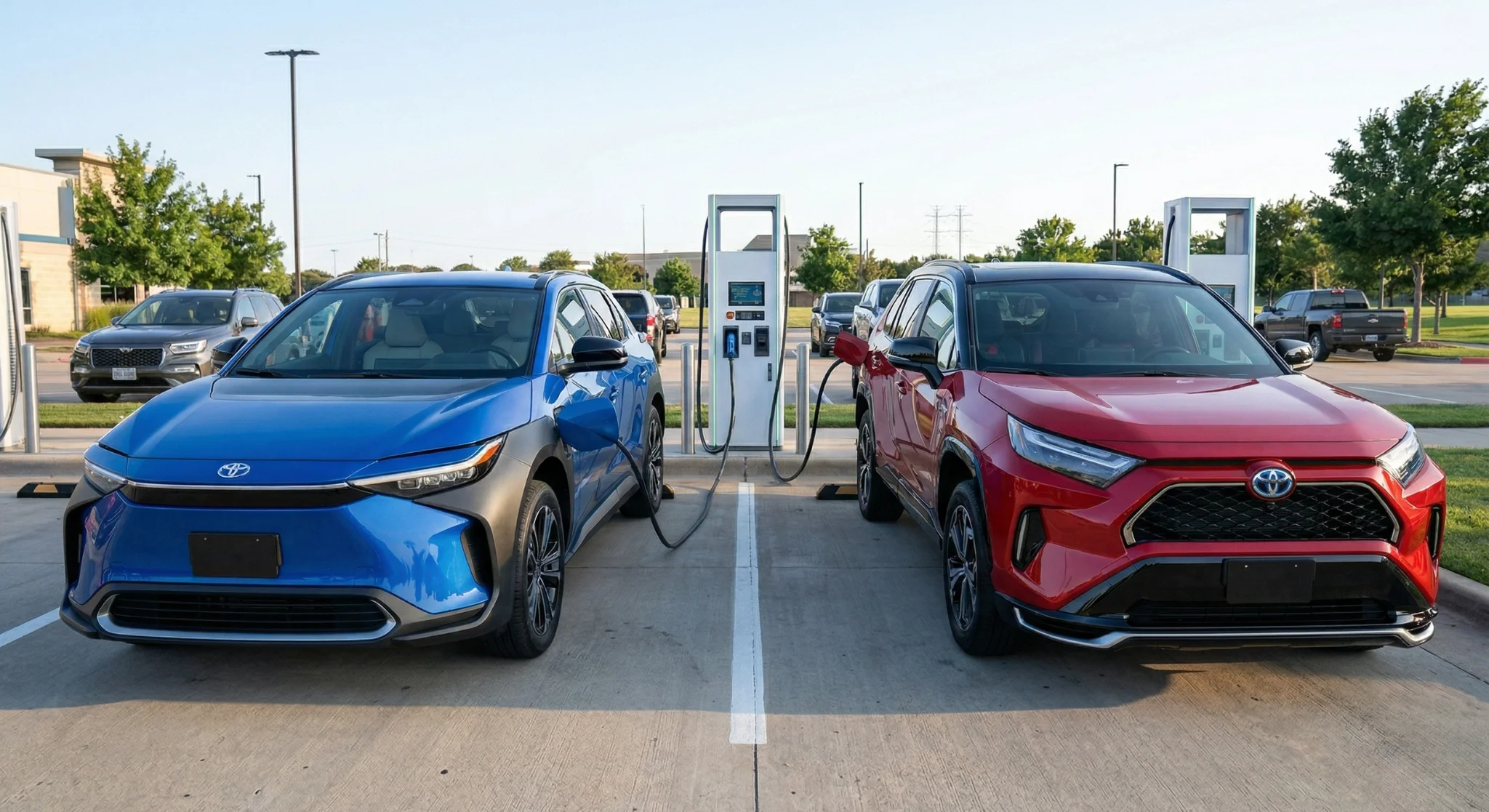
2026 Toyota bZ Range and Battery Performance
The 2026 Toyota bZ features a redesigned powertrain with two battery options. The base XLE FWD uses a 57.7 kWh battery delivering a manufacturer-estimated 236 miles of range. The rest of the lineup — XLE FWD Plus, XLE AWD, and Limited — uses a larger 74.7 kWh battery, with the XLE FWD Plus achieving up to 314 miles on a single charge. AWD models range from 278 to 288 miles depending on trim.
This range comfortably covers daily driving for most North Hollywood and Valley Village commuters, with plenty of margin for errands across Toluca Lake or Sun Valley without needing a midday charge. The bZ produces zero tailpipe emissions and operates quietly, making it well-suited for drivers who can charge regularly at home or at a workplace.
| 2026 bZ Trim | Battery | Est. Range |
|---|---|---|
| XLE FWD | 57.7 kWh | 236 miles |
| XLE FWD Plus | 74.7 kWh | 314 miles |
| XLE AWD | 74.7 kWh | 288 miles |
| Limited FWD | 74.7 kWh | 299 miles |
| Limited AWD | 74.7 kWh | 278 miles |
For 2026, the bZ now features a North American Charging System (NACS) port, giving it native access to thousands of Tesla Supercharger stations nationwide — a significant upgrade over the previous CCS1 connector. DC fast charging at up to 150 kW brings the battery from 10% to 80% in approximately 30 minutes. A new battery preconditioning system warms the pack before fast-charging sessions, improving charge speed consistency in cooler weather. Level 2 charging is supported through an upgraded 11 kW onboard charger, shortening overnight charge times compared to the previous generation.
2026 Toyota RAV4 Plug-in Hybrid Range and Performance
The 2026 RAV4 Plug-in Hybrid is fully redesigned for this model year, delivering up to 52 miles of all-electric range on SE and XSE trims thanks to a larger 22.7 kWh battery — up from 42 miles on the outgoing model. The Woodland trim achieves 49 miles and the GR Sport reaches 48 miles of EV-only driving. For most daily commutes within the San Fernando Valley, this electric range covers the trip without engaging the gasoline engine.
Once the battery depletes, the RAV4 Plug-in Hybrid transitions seamlessly to hybrid mode, combining its 2.5-liter four-cylinder engine with three electric motors for a combined 324 horsepower. In hybrid mode, the SE and XSE trims achieve up to 41 MPG combined, keeping fuel costs low even on longer drives. Standard all-wheel drive across all PHEV trims adds traction and confidence in varied conditions.
| 2026 RAV4 PHEV Trim | EV Range | Combined MPG |
|---|---|---|
| SE | 52 miles | 41 MPG |
| XSE | 52 miles | 41 MPG |
| Woodland | 49 miles | 38 MPG |
| GR Sport | 48 miles | 37 MPG |
New for 2026, the RAV4 Plug-in Hybrid XSE and Woodland trims now support DC fast charging via a CCS1 port, reaching 10% to 80% in approximately 30 minutes. The SE and GR Sport trims use a standard 7 kW onboard charger with Level 2 charging taking roughly four hours for a full charge, while the XSE and Woodland feature an upgraded 11 kW onboard charger for faster home charging.
Charging Comparison: bZ vs. RAV4 Plug-in Hybrid
Charging infrastructure and time matter for daily usability, especially for drivers balancing busy schedules across North Hollywood, Burbank, and Studio City.
The bZ supports DC fast charging across all trims with its NACS port, compatible with Tesla Superchargers and other NACS-equipped stations. At 150 kW, reaching 80% takes about 30 minutes — practical for quick top-ups during longer trips or a lunch break.
The RAV4 Plug-in Hybrid adds DC fast charging for the first time on select trims (XSE and Woodland) using a CCS1 connector, also achieving 10% to 80% in roughly 30 minutes. The SE and GR Sport trims rely on Level 1 and Level 2 charging only. However, because the RAV4 PHEV can switch to gasoline when the battery is depleted, charging urgency is lower — you are never stranded waiting for a charge.
For drivers with consistent home charging access, the bZ's all-electric operation maximizes electric miles and eliminates fuel costs entirely. For those without reliable daily charging or who regularly drive beyond 50 miles, the RAV4 Plug-in Hybrid's gasoline backup provides flexibility without range anxiety.
Pricing Overview at North Hollywood Toyota
The 2026 Toyota bZ starts at an MSRP of $34,900 for the XLE FWD, making it one of the most accessible fully electric SUVs on the market. The range-leading XLE FWD Plus and Limited trims are priced higher, with the Limited AWD near the top of the lineup. The bZ Woodland, a separate longer-bodied model with standard AWD and enhanced off-road capability, starts at $45,300.
The 2026 RAV4 Plug-in Hybrid SE starts at $41,500, with the Woodland at $45,300, XSE at $47,200, and the performance-oriented GR Sport at $48,500. The higher price reflects the dual powertrain system, larger battery, and standard AWD across all PHEV trims.
Both models may qualify for federal EV tax incentives depending on eligibility — speak with a team member at North Hollywood Toyota for current incentive details.
Which Model Fits Your Driving Life?
If your daily driving stays within a 50-mile radius and you have access to home or workplace charging, the bZ's all-electric powertrain can eliminate fuel costs and emissions entirely. Its range of up to 314 miles means even weekend trips across the Valley or beyond rarely require midday charging.
If your schedule is less predictable — longer drives to Valley Glen, Sun Valley, or beyond the San Fernando Valley — or if you don't have consistent charging access, the RAV4 Plug-in Hybrid gives you up to 52 miles of electric driving for daily commutes with gasoline backup for everything else.
Both models feature Toyota Safety Sense driver-assist technology and are built on platforms designed for their respective powertrains. To explore the 2026 Toyota bZ or RAV4 Plug-in Hybrid at North Hollywood Toyota, browse our bZ electric inventory or view RAV4 Plug-in Hybrid availability. You can also call us at (818) 369-3922 to schedule a test drive.