How Often Should You Rotate Your Tires?
How Often Should You Rotate Your Tires?
Keeping up with regular maintenance is one of the most effective ways to protect your vehicle and stay safe on the road. Under normal driving conditions, most drivers should rotate their tires every 5,000 to 7,500 miles. Sticking to this interval spreads tread wear evenly across all four tires, which helps prevent premature wear and keeps your handling balanced. Because the front and rear tires face different steering, braking, and load forces, skipping rotations leads to rapid, uneven wear that can cut thousands of miles off the life of a tire set.
For many drivers, pairing a rotation with every oil change is the easiest way to stay on schedule. If you notice steering wheel vibration, patchy tread wear, or the vehicle pulling to one side before your next mileage milestone, have the tires inspected right away. If you are not sure what your specific model needs, the team at our North Hollywood service center can confirm the right interval for your Toyota.
How Driving Habits and Drivetrains Affect Your Rotation Timeline
The 5,000-to-7,500-mile range is a solid baseline, but your drivetrain and driving habits can shift it. Front-wheel-drive vehicles put heavy stress on the front axle, since those two tires handle power delivery, steering, and most of the braking. A common fix is the forward-cross pattern: the front tires move straight back, while the rear tires cross over to the opposite front positions. A front-wheel-drive Toyota Camry, for example, typically uses this forward-cross pattern.
All-wheel-drive and four-wheel-drive systems send power to all four wheels and hold tighter tread-depth tolerances to protect driveline components. Because of that, all-wheel-drive vehicles are often rotated more often, every 3,000 to 5,000 miles.
How you drive matters just as much as what you drive. Frequent stop-and-go traffic, hard cornering, quick acceleration, and heavy cargo all speed up tire wear. If you regularly haul heavy loads or drive on rough, unpaved roads, you will likely need to rotate sooner than the standard interval to prevent cupping and feathering.
How Tire Age Affects Your Rotation Schedule
Does tire age change how often you should rotate? Yes, because rubber breaks down over time no matter how many miles you drive. Sunlight, heat, and ozone cause the rubber compounds to lose flexibility, a process known as dry rot. So even if you do not drive enough to hit 5,000 miles within six months, you should still have your tires inspected and rotated at least twice a year.
This matters most for vehicles that sit for long stretches or accumulate very low annual mileage. During a rotation, technicians do not just swap positions. They also inspect for fine sidewall cracks, bulges, and tread separation. A parked vehicle's weight presses constantly on the same contact patches, and sitting in one spot for months can create temporary or permanent flat spots in the rubber. Regular rotation redistributes that weight across different sections of the tire structure and helps preserve the casing.
Most tire manufacturers recommend replacing tires once they reach six to ten years of age, regardless of remaining tread depth. That makes periodic, age-based inspections an important safety step.
Tire maintenance and safety information on this page is provided for general educational purposes only and is not a substitute for the guidance in your vehicle's owner's manual or the advice of a certified technician. Recommended intervals and specifications vary by vehicle, tire, and driving conditions. Always consult your owner's manual and a qualified technician for recommendations specific to your vehicle. Tire-safety data referenced from the National Highway Traffic Safety Administration (nhtsa.gov).
Why Skipping Rotations Compromises Your Stopping Distance
When you skip scheduled rotations, you directly compromise your vehicle's ability to stop safely, especially in bad weather. Tires need a flat, uniform contact patch to grip the road. As they wear unevenly, the tread distorts and less rubber actually touches the pavement. That loss of contact increases your stopping distance when you brake.
Uneven wear often shows up as cupping or feathering, where some tread blocks become shorter than others. On wet roads, these uneven grooves cannot channel water away from under the tire, which raises the risk of hydroplaning, when the tire loses contact and slides on a thin layer of water. Tire-safety research shows that unevenly worn or shallow tread needs substantially longer distances to bring a vehicle to a complete stop than a well-maintained, evenly worn set.
Uneven wear also throws off the balance of braking forces. If your front tires are badly worn while the rears keep deep tread, the front axle can lose traction early during hard braking, triggering the anti-lock system sooner and extending your stopping distance. Keeping tires rotated helps all four corners grip with equal strength, keeping stops as short and safe as possible.
Tire maintenance and safety information on this page is provided for general educational purposes only and is not a substitute for the guidance in your vehicle's owner's manual or the advice of a certified technician. Recommended intervals and specifications vary by vehicle, tire, and driving conditions. Always consult your owner's manual and a qualified technician for recommendations specific to your vehicle. Tire-safety data referenced from the National Highway Traffic Safety Administration (nhtsa.gov).
Do You Need a Wheel Alignment with Every Tire Rotation?
A common misconception is that an alignment is needed every time tires are rotated. In reality, these are two different services. A rotation physically swaps wheel positions to balance tread wear, while an alignment adjusts the steering and suspension angles so the tires meet the road at the correct angle.
You do not need an alignment with every rotation. Under normal conditions, an alignment is typically done about once a year, or roughly every 12,000 to 15,000 miles. A rotation is still the perfect time for a technician to check for wear patterns that point to an alignment issue. If the inner or outer edge of a tire wears faster than the center, the camber or toe angle is likely out of spec.
Request an alignment right away if the vehicle veers to one side on a straight road, the steering wheel sits crooked when driving straight, or you feel steering vibration. Hitting a deep pothole or curb can knock the suspension out of alignment instantly. Skipping an alignment during a routine rotation is fine when tires wear evenly, but addressing alignment problems promptly keeps a fresh rotation from being ruined by rapid, uneven wear.
Professional Lift Service vs. DIY Tire Swaps
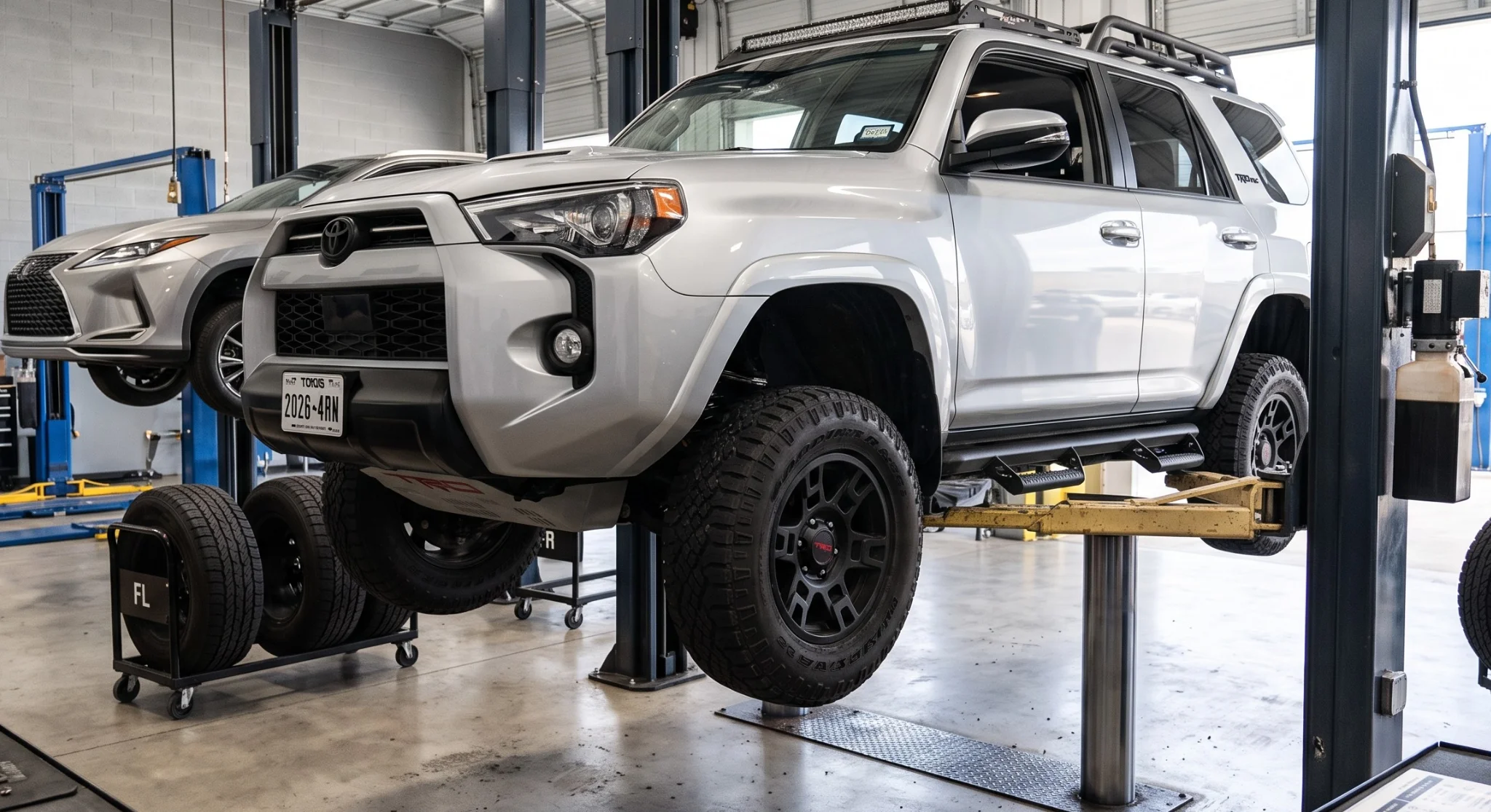
Is it safe to rotate tires at home? A DIY rotation is possible if you have the right tools and physical strength, but a professional service offers real safety and technical advantages. A proper home rotation needs a heavy-duty floor jack, high-capacity jack stands, wheel chocks, and a calibrated torque wrench. Rotating tires with only the emergency scissor jack that comes with your vehicle is dangerous and should never be attempted.
At a professional service center, the process goes well beyond swapping wheels. A professional service includes:
- Raising the vehicle safely on a hydraulic frame lift for full stability.
- Removing all four wheels to inspect the brake pads, rotors, calipers, and suspension for hidden wear.
- Checking and adjusting pressure on every tire, including the spare, to the manufacturer's cold specifications.
- Inspecting tread with precise depth gauges to catch subtle wear.
- Re-torquing every lug nut to factory specifications to prevent wheel damage or loosening.
Service centers also have balancing machines. If a tire has developed a slight imbalance over thousands of miles, technicians can spin-balance the assemblies before remounting them. That eliminates the high-speed vibration a DIY garage rotation cannot address, for a smoother, quieter, safer ride.
Common Questions About Toyota Tire Maintenance
How do I know if my tires are too old to drive on safely?
Check the DOT Tire Identification Number on the sidewall. The last four digits show the week and year the tire was made. A code ending in 1224, for example, means the tire was built in the 12th week of 2024. Most manufacturers recommend replacing tires that are six to ten years old regardless of remaining tread, because the rubber compounds naturally weaken over time.
Does my tire pressure monitoring system let me skip manual pressure checks?
No. The tire pressure monitoring system warns you only when a tire is significantly underinflated, usually after it has lost 25 percent or more of its recommended pressure. It is not a substitute for regular maintenance. Check your tire pressure with a reliable hand gauge at least once a month when the tires are cold to protect fuel economy and even wear.
Can I rotate my tires if they are different sizes front and rear?
If your vehicle has a staggered fitment where the rear tires are wider than the front, you cannot do a standard front-to-back rotation. If the tires are non-directional, they can sometimes be rotated side-to-side across the same axle. If they are both staggered and directional, they cannot be rotated at all without unmounting them, and you replace them as they wear.
What should I do if my vehicle starts vibrating right after a rotation?
A slight change in road feel is normal for the first few miles as the tires settle into their new positions, but significant vibration is not. If the steering wheel or seat vibrates at highway speeds after a service, the wheels usually need balancing, or a tire has an irregular wear pattern that was masked in its old position. Have a technician inspect the balance and suspension.
Is it necessary to rotate the spare tire into the pattern?
If your vehicle has a matching, full-size spare, it can be worked into a five-tire rotation to extend the life of the whole set. But a temporary donut spare, or an older full-size spare that does not match the active set, should never be rotated into regular use. Temporary spares are strictly for short-term emergency use to reach a service center.
Keep Your Tires Rolling Safely
If you have questions about your tire wear or want a certified technician to check your tread depth, the team at our North Hollywood service center is ready to help.
Visit us at 4606 Lankershim Blvd, North Hollywood, CA 91602 or call 818-369-3922.
Disclosures
Tire maintenance and safety information on this page is provided for general educational purposes only and is not a substitute for the guidance in your vehicle's owner's manual or the advice of a certified technician. Recommended intervals and specifications vary by vehicle, tire, and driving conditions. Always consult your owner's manual and a qualified technician for recommendations specific to your vehicle. Tire-safety data referenced from the National Highway Traffic Safety Administration (nhtsa.gov).