Budget, paperwork, financing, and the test drive — start to finish
First-Time Car Buyer Guide: What to Expect in North Hollywood
Buying your first car follows a predictable sequence: set a total budget, get pre-approved, choose a vehicle that fits how you actually drive, test drive it properly, negotiate on the out-the-door price rather than the monthly payment, and sign. Know your monthly ceiling before you shop, but negotiate on the total price — a payment target can always be met by stretching the loan term, which raises what you pay overall. Arriving with your paperwork already gathered keeps the whole thing short.
What to Bring
Dealerships typically request the following before a credit application can move:
- A valid driver's license
- Recent pay stubs or tax documents showing current income
- A recent utility bill confirming your address
- An active auto insurance binder or quote
Where the Shopping Starts
Once documents are handled, the decision shifts from research to real inventory. Compact sedans carry the lowest entry prices and the smallest fuel bills. Compact crossovers trade some efficiency for a higher seating position and more cargo room. Reviewing the window sticker on any vehicle you are considering shows the baseline equipment, factory option packages, and warranty coverage before you commit.
At North Hollywood Toyota, our team walks first-time shoppers through each stage — from out-the-door cost breakdowns to warranty coverage. Drivers across North Hollywood, Toluca Lake, Valley Village, Burbank, Studio City, Sun Valley, and Valley Glen start here. Call (818) 369-3922 with questions before your first visit.
Which Toyota Body Style Fits a First-Time Buyer?
Four categories, and where new buyers usually land
Toyota's lineup covers four broad categories. First-time buyers usually land in the first two, where entry pricing and running costs are lowest.
Models Available by Body Style
| Body Style | Models Available at North Hollywood Toyota |
|---|---|
| Cars & Minivan | Corolla, Camry, Prius, Crown, Mirai, Sienna |
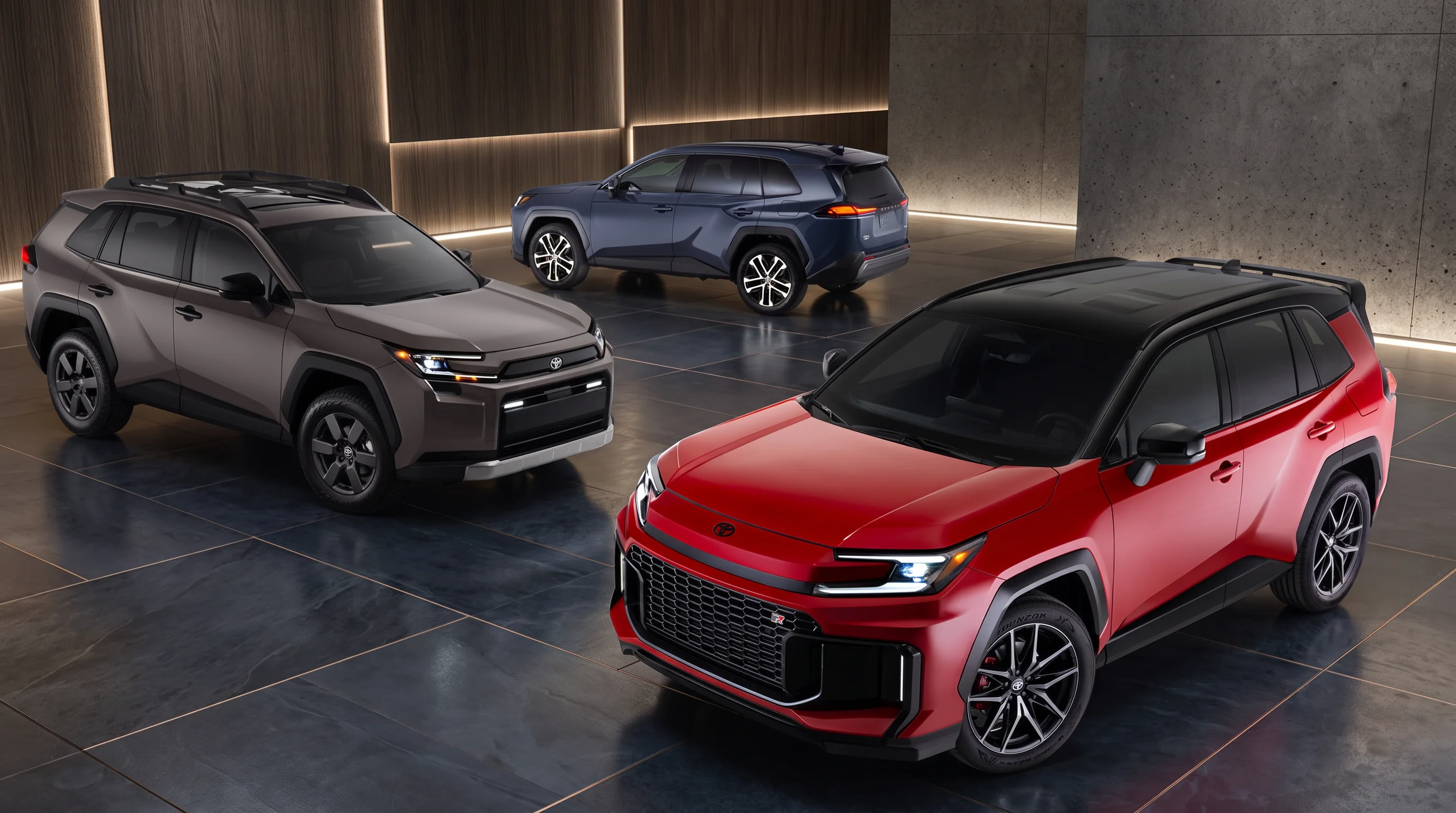
| SUVs & Crossovers | Corolla Cross, RAV4, Crown Signia, C-HR, bZ, Highlander, Grand Highlander, 4Runner, Land Cruiser, Sequoia |
| Trucks | Tacoma, Tundra |
| Performance | GR Corolla, GR86, GR Supra |
You can browse specs and inventory for every one of these on our full Toyota lineup page.
Where First-Time Buyers Typically Start
| Model | Body Style | Starting TSRP* | EPA-Estimated Fuel Economy |
|---|---|---|---|
| Corolla LE | Compact sedan | $23,920* | Up to an EPA-estimated 35 MPG combined |
| Camry LE | Mid-size hybrid sedan | $30,195* | Up to an EPA-estimated 51 MPG combined |
| RAV4 LE | Compact hybrid SUV | $33,350* | Up to an EPA-estimated 43 MPG combined |
*Total Suggested Retail Price (TSRP) for new vehicles includes manufacturer and distributor options and delivery, processing, and handling fees, which are subject to change at any time. TSRP excludes taxes, title, license, dealer-installed options, accessories, fees and charges. TSRP is not the dealer advertised price. Dealer price will vary. The dealer sets the final price.
The Corolla is also offered as a hybrid, rated up to an EPA-estimated 50 MPG combined. Every 2026 Camry is a hybrid — there is no gas-only version. Every 2026 RAV4 is a hybrid or plug-in hybrid, and the LE comes standard with front-wheel drive, with all-wheel drive available as an option.
EPA-estimated fuel economy figures are for comparison purposes only. Your actual mileage will vary depending on driving conditions, how you drive and maintain your vehicle, battery age/condition, and other factors.
How Much Car Can You Afford?
A framework that keeps the payment from running your budget
A widely used guideline is the 20/4/10 rule: put 20% down, finance for four years or less, and keep total monthly transportation costs at or below 10% of gross monthly income.
| Component | What It Means | Why It Matters |
|---|---|---|
| 20% down | On a $23,920* Corolla LE, roughly $4,784 | Lowers the financed balance and offsets early depreciation |
| 4-year term | 48 months or less | Longer terms lower the payment but raise total interest and extend the period you owe more than the car is worth |
| 10% of income | Loan payment, insurance, fuel, and maintenance combined | Keeps transportation from crowding out housing, savings, and everything else |
*Total Suggested Retail Price (TSRP) for new vehicles includes manufacturer and distributor options and delivery, processing, and handling fees, which are subject to change at any time. TSRP excludes taxes, title, license, dealer-installed options, accessories, fees and charges. TSRP is not the dealer advertised price. Dealer price will vary. The dealer sets the final price.
We have broken this framework down in far more detail — including how to run the numbers against your own income — in our guide on how much car you can actually afford.
How Does Financing Work With Limited Credit?
What lenders look at when there is no long credit history
Most first-time buyers are not working against bad credit — they are working with a thin file. That means a credit record exists, but it does not yet carry enough account history for a scoring model to rate it. That is a different situation from having no credit record at all, which is far less common, and lenders approach the two differently. Either way, limited history is not a dead end; it just shifts what the underwriter looks at.
What Lenders Look At When Credit History Is Thin
A thin file means limited installment or credit card history — unproven, not bad. Underwriters weigh other signals:
- Income stability — consecutive pay stubs or tax returns
- Employment history — length of time with a current employer
- Debt-to-income ratio — existing obligations measured against monthly income
Three Ways to Strengthen an Application
| Approach | How It Helps |
|---|---|
| Add a co-signer | A co-signer with established credit guarantees repayment, which can allow the lender to price the rate on their credit profile while the loan stays in the primary borrower's name |
| Increase the down payment | A lower loan-to-value ratio reduces lender exposure and can widen approval options |
| Arrive documented | Applications submitted with income and residency proof in hand move faster than those without |
As on-time payments accumulate, the primary borrower builds credit history of their own.
Programs Available Through Our Finance Center
Two rebate programs run through Toyota Financial Services that first-time buyers frequently qualify for. Both require that the vehicle be purchased or leased through a participating Toyota dealer and Toyota Financial Services, and the two cannot be combined with each other:
- College Rebate — a $500 rebate on all new, unlicensed Toyota models for buyers who graduated within the previous two years, or who are currently enrolled in or graduating within six months from an eligible undergraduate or graduate program, with proof of current employment
- Military Rebate — a $500 rebate for eligible active-duty and inactive-reserve personnel, military retirees, veterans within two years of their discharge date, and household members of eligible personnel, including Gold Star family members
You can review the full program list on our finance center page.
All financing is subject to credit approval; not all buyers will qualify. Rates and terms vary by lender and applicant profile. The dealer and lender set the final terms. Rebate amounts, eligibility, and program windows are set by Toyota Motor North America and Toyota Financial Services and are subject to change.
Is Certified Pre-Owned Right for a First-Time Buyer?
Two certification tiers, two very different levels of coverage
Certified Pre-Owned sits between a new car and a private-party used car: lower price than new, with factory inspection and warranty coverage that a private sale cannot offer.
Toyota Certified Used Vehicles must meet age and mileage criteria before undergoing a factory quality assurance inspection, and the inspection standard differs by tier. Gold Certified vehicles complete a 160-point inspection — 174 points for certified hybrids — while Silver Certified vehicles complete a 136-point minimum inspection. Factory-trained technicians inspect and recondition major mechanical systems, brakes, suspension, tires, climate and electrical systems, and safety equipment.
Coverage by Ownership Category
| Category | Eligibility | Warranty Coverage | Inspection |
|---|---|---|---|
| New Toyota | Brand-new, never titled | 36-month/36,000-mile basic; 5-year/60,000-mile powertrain; 8-year/100,000-mile hybrid component coverage; 10-year/150,000-mile hybrid battery coverage on 2020 and newer hybrids | Factory new |
| Gold Certified | Up to 6 model years old, 85,000 miles or less | 12-month/12,000-mile limited comprehensive, 7-year/100,000-mile limited powertrain, plus 7-year/100,000-mile 24-hour roadside assistance | 160-point (174 for hybrids) |
| Silver Certified | Up to 10 model years old, 60,000–125,000 miles, outside Gold eligibility parameters | 12-month/12,000-mile limited powertrain plus 12-month/12,000-mile roadside assistance | 136-point minimum |
| Standard Used | No Toyota certification; varies by seller | As-is or third-party coverage | Basic safety check |
Gold Certified limited powertrain coverage runs for 7 years or 100,000 total vehicle miles, whichever comes first, from the date of Certified Used Vehicle purchase. Ask which tier a specific vehicle carries before you sign — the difference between Gold and Silver is significant on a first-time buyer's budget.
Source: certification tiers, inspection standards, and coverage terms are per the Toyota Certified Used Vehicle program; new vehicle coverage is per Toyota's New Vehicle Limited Warranty terms. See the TCUV Warranty Supplement and your Warranty & Maintenance Guide for complete details.
This information is provided for general educational purposes only and does not constitute legal advice. Warranty coverage depends on the specific terms of your vehicle's warranty agreement. Consult your owner's manual or a qualified legal professional for guidance on your individual situation.
What Should You Check on a Test Drive?
Two passes, two different checklists
Test the vehicle across both surface streets and highway speeds.
Before You Start the Engine
- Seat position, legroom, pedal reach, and head clearance
- Steering column tilt and telescoping adjustment
- Sightlines through the windshield, side mirrors, and rear glass
- Reach to climate controls, turn signals, window switches, and touchscreen menus
Once You Are Moving
- Transmission smoothness and pedal travel under acceleration
- Braking response — firm and linear, without vibration
- Steering alignment and on-center stability
- Cabin noise at highway speed, including wind and road noise
- Steering effort during tight turns and parking maneuvers
Camry and RAV4 both pair a 2.5L four-cylinder with an electronically controlled CVT, which delivers power differently than a conventional automatic — worth feeling for yourself before deciding.
Which Safety and Technology Features Matter Most?
Standard across the lineup — no trim climbing required
Active safety systems come standard across Toyota's core lineup, which means a first-time buyer does not have to climb trim levels to get them.
| Model | Safety Suite |
|---|---|
| Corolla | Toyota Safety Sense™ 3.0 |
| Camry | Toyota Safety Sense 3.0 |
| RAV4 | Toyota Safety Sense™ 4.0 — the newest generation, debuting on the 2026 RAV4 |
What the Suite Includes
- Pre-Collision System with Pedestrian Detection — scans ahead and can apply braking if a frontal collision risk is detected
- Dynamic Radar Cruise Control or Full-Speed Range Dynamic Radar Cruise Control — maintains a set following distance; the full-speed range version adjusts down to a stop in traffic. Which version is fitted varies by model and trim
- Lane Departure Alert with Steering Assist — warns on drift and can apply slight steering correction
- Lane Tracing Assist — helps keep the vehicle centered when cruise control is engaged
- Road Sign Assist — reads speed limit, stop, Do Not Enter, and yield signs and displays them in the instrument cluster
- Proactive Driving Assist — included in both Toyota Safety Sense 3.0 and Toyota Safety Sense 4.0; uses camera and radar to provide gentle braking or steering support for routine driving tasks such as maintaining distance from a preceding vehicle
Blind Spot Monitor with Rear Cross-Traffic Alert is standard on Corolla, Camry, and RAV4. Wireless Apple CarPlay® and Android Auto™ put navigation, messaging, and audio on the center screen with voice control, which keeps hands on the wheel.
Quick Answers for First-Time Car Buyers
The questions that come up most on the showroom floor
How much should a first-time buyer put down?
The 20/4/10 framework recommends 20% down. A larger down payment reduces the financed balance, lowers the monthly payment, cuts total interest, and protects against negative equity early in the loan.
Sedan or compact SUV?
Corolla and Camry offer lower entry prices and stronger EPA-estimated fuel economy — the budget-focused commuter picks. RAV4 offers a higher seating position, more cargo room, and available all-wheel drive for a higher starting price.
What documents are required?
A valid driver's license, proof of income, proof of residency, and active insurance coverage. Complete documentation speeds up underwriting.
Does a Certified vehicle need a separate inspection?
Toyota Certified Used Vehicles are inspected before reaching the lot. Gold Certified vehicles complete a 160-point inspection — 174 points for hybrids — and Silver Certified vehicles complete a 136-point minimum inspection. You are welcome to review the inspection checklist and vehicle history report with our staff before purchasing.
Ready to Take the Next Step?
Buying your first car comes down to three things: a budget you set before you shop, documentation gathered in advance, and a test drive thorough enough to tell you whether the car fits your life. Our team is here to answer questions at any stage.
Visit us at 4606 Lankershim Blvd, North Hollywood, CA 91602