2026 Toyota 4Runner TRD Pro vs. Trailhunter: Which Off-Road Flagship Is Right for You?
2026 Toyota 4Runner TRD Pro vs. Trailhunter: Which Off-Road Flagship Is Right for You?
The sixth-generation Toyota 4Runner tops its nine-grade 2026 lineup with two very different off-road flagships: the TRD Pro and the Trailhunter. Both run exclusively on the i-FORCE MAX hybrid powertrain and both are built for serious terrain — but they are tuned for two completely different styles of adventure. The TRD Pro is engineered to run fast over open desert; the Trailhunter is built to crawl slowly and self-supported deep into the backcountry. Here is how they actually compare, and how to decide.
What the TRD Pro and Trailhunter Share
Same capability, two tuning philosophies
Under the skin, these two flagships have far more in common than their badges suggest. Both are powered exclusively by the i-FORCE MAX hybrid — a 2.4-liter turbocharged four-cylinder paired with an electric motor, sent through an 8-speed automatic and producing the same 465 lb-ft of torque. Peak horsepower differs slightly: the TRD Pro is rated at 326 horsepower, while the Trailhunter is rated at 323 horsepower because of its unique high-mount air intake and exhaust routing. Both use part-time four-wheel drive with a two-speed transfer case, active traction control, and a standard electronic locking rear differential. And both include the Stabilizer Disconnect Mechanism (SDM), which electronically disconnects the front sway bar at the push of a button for dramatically increased suspension articulation on the trail.
They also share their hard capability numbers: 10.1 inches of ground clearance, 33-inch Toyo Open Country A/T III tires on 18-inch wheels, a 5,800-pound maximum tow rating, five-passenger seating, and roughly 42.6 cubic feet of cargo behind the second row. Inside, both come standard with the 14-inch Toyota Audio Multimedia touchscreen and a 12.3-inch digital gauge cluster. Because both use the i-FORCE MAX, both also include a 2,400-watt AC power supply with cabin and cargo-area outlets plus prewired auxiliary switches for accessories — equipment that is standard across the hybrid grades, not exclusive to either flagship.
TRD Pro: Built for High-Speed Desert Running
The Baja-inspired specialist
The TRD Pro’s defining hardware is its suspension. It rides on TRD-tuned FOX 2.5-inch internal-bypass QS3 shocks with rear remote reservoirs and manually adjustable compression settings, letting drivers tune damping for high-speed gravel and desert whoops — or firmer pavement manners. The valving is designed to resist fade under repeated hard hits at speed. The TRD Pro adds a TRD performance air intake and exhaust and a power moonroof, and it is set apart visually by 18-inch matte-black alloy wheels. On pavement it rides a touch firmer and sportier — the tradeoff for its high-speed composure.
Trailhunter: Built for Self-Supported Overlanding
The factory-equipped overlander
The Trailhunter is engineered for slow, technical trails and multi-day expeditions. Developed with off-road specialist ARB, it rides on Old Man Emu (OME) 2.5-inch forged monotube shocks with rear piggyback reservoirs, valved to carry heavy overlanding loads without sagging and to stay composed at low speeds. It layers on purpose-built overlanding hardware: an ARB roof rack, a high-clearance front bumper, frame-mounted steel rock rails, a low-profile high-mount air intake for dusty and wet crossings, and an onboard air compressor in the cargo area for re-inflating tires after airing down. Its 18-inch wheels wear a distinctive bronze finish. The result is a rig ready to leave the pavement straight off the showroom floor.
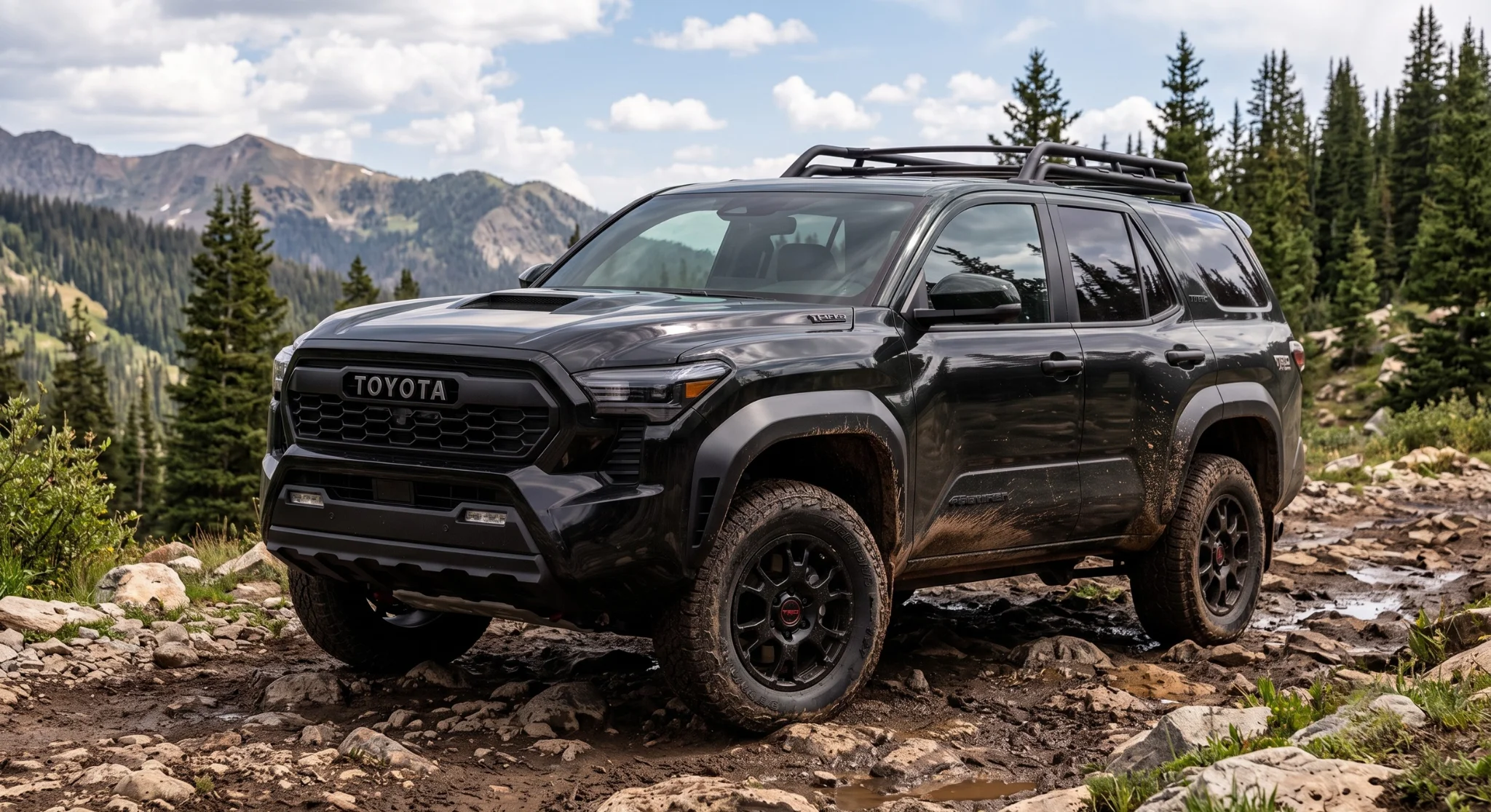
TRD Pro vs. Trailhunter: Side-by-Side
Verified 2026 specifications
2026 4Runner TRD Pro vs. Trailhunter — Specifications
| Spec | TRD Pro | Trailhunter |
|---|---|---|
| Powertrain | i-FORCE MAX 2.4L turbo hybrid | i-FORCE MAX 2.4L turbo hybrid |
| Horsepower / Torque | 326 hp / 465 lb-ft | 323 hp / 465 lb-ft |
| Transmission | 8-speed automatic | 8-speed automatic |
| Drivetrain | Part-time 4WD, 2-speed transfer case | Part-time 4WD, 2-speed transfer case |
| Ground clearance | 10.1 in | 10.1 in |
| Max towing | 5,800 lbs | 5,800 lbs |
| Curb weight | 5,455 lbs | 5,500 lbs |
| Cargo (behind 2nd row / max) | 42.6 / 82.6 cu ft | 42.6 / 82.6 cu ft |
| Seating | 5 | 5 |
| EPA-Estimated MPG | 23 city / 24 hwy | 23 city / 24 hwy |
| Front / rear shocks | FOX 2.5″ internal-bypass QS3, rear remote reservoirs | Old Man Emu 2.5″ forged monotube, rear piggyback reservoirs |
| Wheels | 18″ matte-black alloy | 18″ bronze-finish alloy |
| Tires | 33″ Toyo Open Country A/T III | 33″ Toyo Open Country A/T III |
| Stabilizer Disconnect (SDM) | Standard | Standard |
| Signature gear | TRD performance intake & exhaust, power moonroof | ARB roof rack, high-mount air intake, onboard air compressor, frame-mounted rock rails, high-clearance front bumper |
| Prewired aux switches / 2,400W AC | Standard | Standard |
| Starting TSRP | ~$69,850 | ~$69,650 |
TSRP on new inventory covers manufacturer/distributor equipment and logistics fees, all of which are subject to revision. It does not account for taxes, registration, dealer-installed additions, or other local charges. TSRP is not a retail advertisement; actual dealer pricing will vary. The dealer sets the final price.
Which 2026 4Runner Flagship Should You Choose?
The choice is about how you use the trail, not how capable each truck is
On paper, the capability of these two flagships is nearly identical — so the right pick comes down to how and where you drive.
Best pick by use case
| Best for | Winner | Why |
|---|---|---|
| Fast, open desert & gravel | TRD Pro | Adjustable FOX QS3 damping tuned for high-speed impacts |
| Slow, technical trails & rock crawling | Trailhunter | Load-tuned OME shocks plus frame-mounted underbody armor |
| Multi-day overlanding & self-support | Trailhunter | Factory ARB rack, onboard air compressor, high-mount intake |
| On-road daily comfort | Trailhunter | More planted, composed ride when loaded; TRD Pro rides firmer |
| Value | Trailhunter | Starts slightly lower while including more factory overlanding gear |
Both are genuine trail-ready flagships. The Trailhunter simply arrives overland-equipped, while the TRD Pro is the high-speed specialist. If you are unsure, explore the 2026 4Runner lineup and compare them in person.
Common Questions: 2026 4Runner TRD Pro & Trailhunter
Quick answers before you visit
Is the Trailhunter more expensive than the TRD Pro?
No — the Trailhunter starts slightly lower. On a TSRP basis it comes in about $200 under the TRD Pro, even though it includes more factory overlanding equipment. Both sit at the top of the 2026 lineup, so the decision comes down to driving style rather than price.
How much can the TRD Pro and Trailhunter tow?
Both are rated to tow up to 5,800 pounds. That is slightly below the 6,000-pound rating of the non-hybrid gas 4Runners, reflecting the added weight of the i-FORCE MAX hybrid components.
Maximum towing and payload capacity figures are based on properly equipped vehicles and vary by configuration. Do not exceed any weight rating. See your owner’s manual and the vehicle’s door-jamb label for specific capacities.
Can I get a third row in either flagship?
No. Third-row seating is available only on the SR5 and Limited grades. Because the i-FORCE MAX hybrid battery is packaged under the rear floor, the TRD Pro and Trailhunter are five-passenger-only.
What is the fuel economy?
Both carry an EPA-Estimated rating of 23 mpg city and 24 mpg highway — strong figures for body-on-frame midsize SUVs riding on 33-inch all-terrain tires.
EPA-estimated fuel economy figures are for comparison purposes only. Your actual mileage will vary depending on driving conditions, how you drive and maintain your vehicle, battery age/condition, and other factors.
See the 2026 4Runner Flagships in Person
Whether you are chasing speed or self-supported adventure, our team at North Hollywood Toyota can walk you through both the TRD Pro and the Trailhunter.
Visit us at 4606 Lankershim Blvd, North Hollywood, CA 91602 · 818-369-3922
Disclosures
TSRP on new inventory covers manufacturer/distributor equipment and logistics fees, all of which are subject to revision. It does not account for taxes, registration, dealer-installed additions, or other local charges. TSRP is not a retail advertisement; actual dealer pricing will vary. The dealer sets the final price.
Maximum towing and payload capacity figures are based on properly equipped vehicles and vary by configuration. Do not exceed any weight rating. See your owner’s manual and the vehicle’s door-jamb label for specific capacities.
EPA-estimated fuel economy figures are for comparison purposes only. Your actual mileage will vary depending on driving conditions, how you drive and maintain your vehicle, battery age/condition, and other factors.