What Is Regenerative Braking and How Does It Work?
What Is Regenerative Braking and How Does It Work?
Regenerative braking is one of the technologies that quietly powers every hybrid, plug-in hybrid, and electric vehicle on the road today. Unlike conventional brakes that throw away kinetic energy as heat, regenerative braking captures that energy and converts it back into electricity to recharge the battery. Whether you drive a Toyota Prius through Studio City, a RAV4 Hybrid around Burbank, or are eyeing the all-electric 2026 Toyota bZ, regenerative braking is doing real work every time you slow down.
Here's how it works — and how Toyota specifically chose to implement it.
How Regenerative Braking Works
The Basic Process
Every electrified vehicle has at least one electric motor and a battery. When you accelerate, the battery sends electricity to the motor, which turns the wheels. Regenerative braking simply reverses that flow.
When you lift off the accelerator or apply the brakes, the electric motor switches roles and acts as a generator. The wheels turn the motor, the motor produces electricity, and that electricity flows back into the battery. The resistance created by this generator effect is what slows the vehicle.
Conventional friction brakes still exist on every hybrid and EV. They take over for hard stops, very low-speed maneuvering, and emergency braking. But for most everyday deceleration — coasting up to a red light, easing off speed on the 101, slowing in stop-and-go traffic through Toluca Lake — the regenerative system handles most of the work without the brake pads ever touching the rotors. Less heat, less wear, less wasted energy.
Factors That Affect Energy Recovery
Not every braking event recovers the same amount of energy. A few real-world variables determine how much electricity makes it back to the battery:
| Factor | Effect on Regen | What Drivers Notice |
|---|---|---|
| Battery state of charge | A near-full battery limits how much energy regen can store | Friction brakes engage more on long downhills with a topped-off battery |
| Temperature | Cold batteries accept charge more slowly | Reduced regen response on cold mornings |
| Vehicle speed | Higher speed carries more recoverable kinetic energy | Below roughly 5 mph, friction brakes take over almost entirely |
How Toyota Implements Regenerative Braking
This is where Toyota's approach diverges from some other manufacturers — and it's an intentional engineering decision worth understanding before you test-drive. First, here's the 2026 electrified lineup where regenerative braking is at work:
| Powertrain Type | 2026 Toyota Models | How They're Charged |
|---|---|---|
| Hybrid (HEV) | Prius, Corolla Hybrid, Camry, RAV4 Hybrid, Highlander Hybrid, Grand Highlander Hybrid, Crown, Crown Signia | Self-charging — no plug needed |
| Plug-in Hybrid (PHEV) | Prius Plug-in Hybrid, RAV4 Plug-in Hybrid | Self-charging plus external plug-in for extended electric range |
| Battery Electric (BEV) | 2026 Toyota bZ | External charging only |
Toyota Hybrids and Hybrid Synergy Drive
The 2026 Toyota Prius, Corolla Hybrid, Camry (now hybrid-only for 2026), RAV4 Hybrid, Highlander Hybrid, Grand Highlander Hybrid, Crown, and Crown Signia all use Toyota's Hybrid Synergy Drive — the powertrain that automatically blends gas and electric power as you drive.
Regenerative braking is built into this system and runs continuously in the background. There's no button to press, no level to choose. Toyota has confirmed that on models like the RAV4 Hybrid, regenerative braking is always on and cannot be turned off — it's simply part of how the car operates. Every time you brake or coast, the system captures energy and routes it to the hybrid battery.
Because Toyota hybrids are self-charging, they never need to be plugged in. The battery is replenished entirely by the engine and by regenerative braking during driving. Plug-in models like the 2026 Prius Plug-in Hybrid and RAV4 Plug-in Hybrid add external charging on top of this, giving them additional all-electric range for daily commutes around the Valley.
The "B" Mode on Toyota Hybrids
You may have noticed a "B" position on the shifter of your Toyota hybrid. This isn't an additional regen level — it's engine braking mode, designed for long downhill descents.
When you shift into B, the system uses engine drag to help slow the vehicle, sparing the brake pads on steep grades — useful on the descent from the Hollywood Hills down toward North Hollywood, or any extended downhill stretch. For everyday flat-road driving, B mode isn't recommended; it actually reduces efficiency. Stick with D for normal driving and let the system handle regen automatically.
The 2026 Toyota bZ and Regenerative Braking Boost Mode
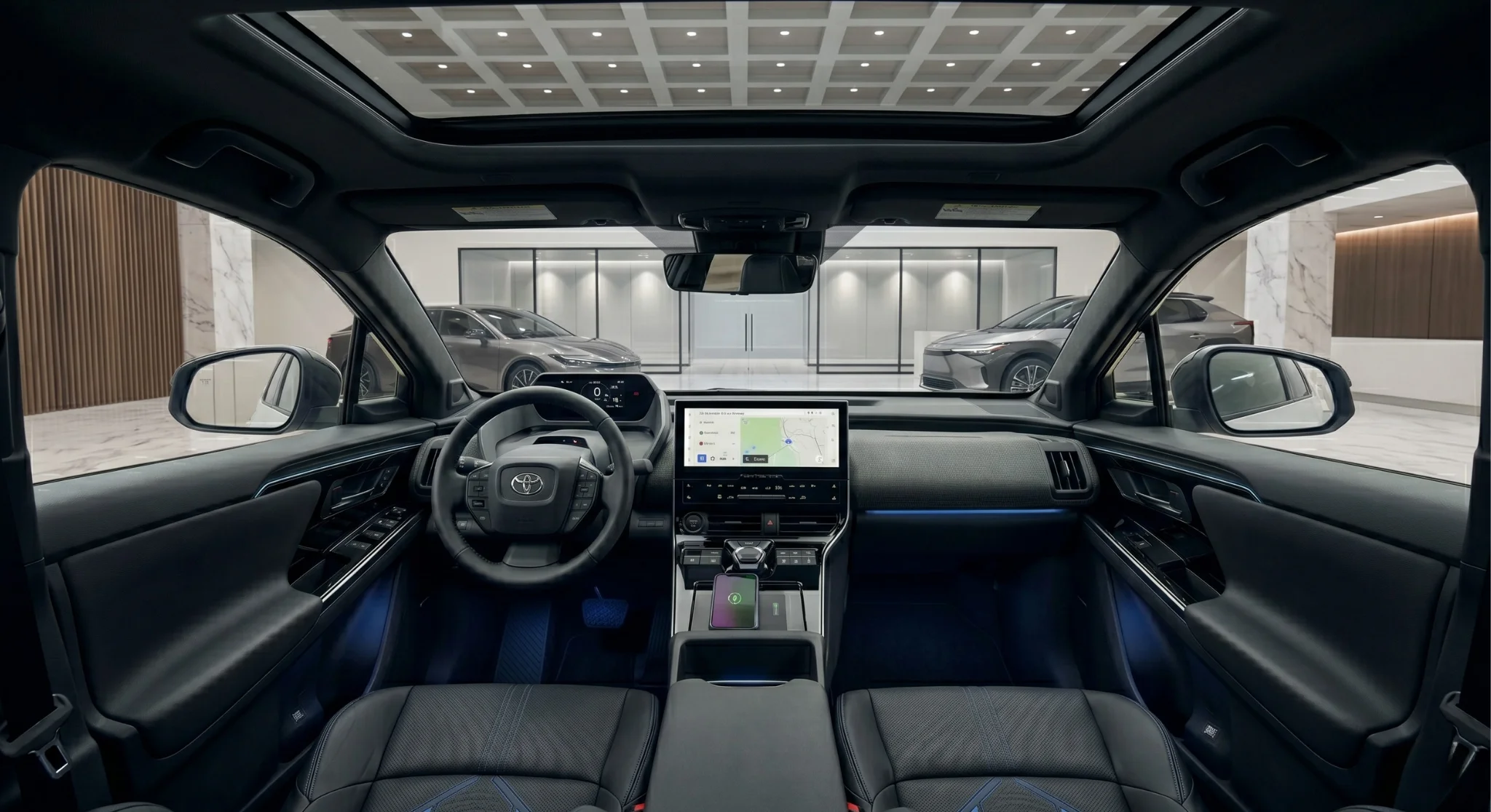
Toyota's all-electric 2026 bZ (the refreshed model formerly known as the bZ4X) adds a feature called Regenerative Braking Boost Mode. Pressing the Boost Mode button increases regen strength so the vehicle slows more aggressively when you lift off the accelerator — closer to what some drivers call one-pedal driving.
Important to know: Boost Mode slows the bZ down to roughly 5 mph, but it does not bring the vehicle to a complete stop. You'll still press the brake pedal to come to a full stop. This is a deliberate Toyota design choice, not a limitation. Engineers built the system to deliver strong energy recovery without the aggressive deceleration that can feel unfamiliar to drivers coming from traditional vehicles.
Comparing Driver Controls Across the Lineup
Here's a quick reference for how regenerative braking presents itself in each part of Toyota's electrified lineup:
| Vehicle Type | Driver Control | What It Does |
|---|---|---|
| Toyota Hybrids (HEVs) | "B" position on shifter | Increases engine braking for steep downhills — not an adjustable regen level |
| Toyota Plug-in Hybrids (PHEVs) | No special regen control | System manages regen automatically; "B" mode behavior similar to HEVs where available |
| 2026 Toyota bZ (BEV) | Regenerative Braking Boost Mode button | Stronger regen on accelerator lift; slows to roughly 5 mph but does not bring the vehicle to a complete stop |
Why Toyota's Balanced Approach Matters
Many EV makers push hard on aggressive one-pedal driving where the vehicle stops completely without any brake pedal input. Toyota took a different path. The result is a driving feel that's noticeably more familiar to anyone transitioning from a gas vehicle — gentler deceleration on accelerator lift-off, the brake pedal stays in the loop for full stops, and the transition from regen to friction braking happens seamlessly behind the scenes.
For shoppers in North Hollywood, Studio City, Burbank, and Valley Village considering their first hybrid or EV, this matters. Driving a 2026 RAV4 Hybrid or bZ feels close to driving a familiar gas car — without giving up any of the energy recovery benefits.
Where Regenerative Braking Makes the Biggest Difference
City Driving: Where Regen Shines
Regenerative braking pays off most in stop-and-go city driving. Every red light on Lankershim, every slow crawl on the 134 — those are energy recapture opportunities. The frequent deceleration cycles let the system harvest energy that would otherwise be lost, contributing directly to better fuel economy in hybrids and extended range in EVs.
Highway Driving: Smaller but Still There
On the highway, the benefit is smaller. Steady cruising doesn't offer many braking events, so most of the efficiency advantage of Toyota's electrified vehicles on the highway comes from the powertrain itself rather than regen. But regen still helps any time you slow for traffic, exit the freeway, or roll up to a stop.
Brake Longevity: A Long-Term Ownership Savings
There's a secondary benefit worth noting: brake longevity. Because regen handles so much of the routine braking, friction pads and rotors typically last significantly longer on hybrids and EVs than on comparable gas vehicles. Fewer brake jobs over the life of the vehicle is a real ownership savings that compounds year after year.
Experience It at North Hollywood Toyota
The best way to understand regenerative braking is to feel it. Lift off the accelerator in a 2026 Prius or RAV4 Hybrid and you'll sense the difference — smooth, controlled deceleration that's quietly putting energy back into the battery. Press the Boost Mode button in a bZ and the experience changes again.