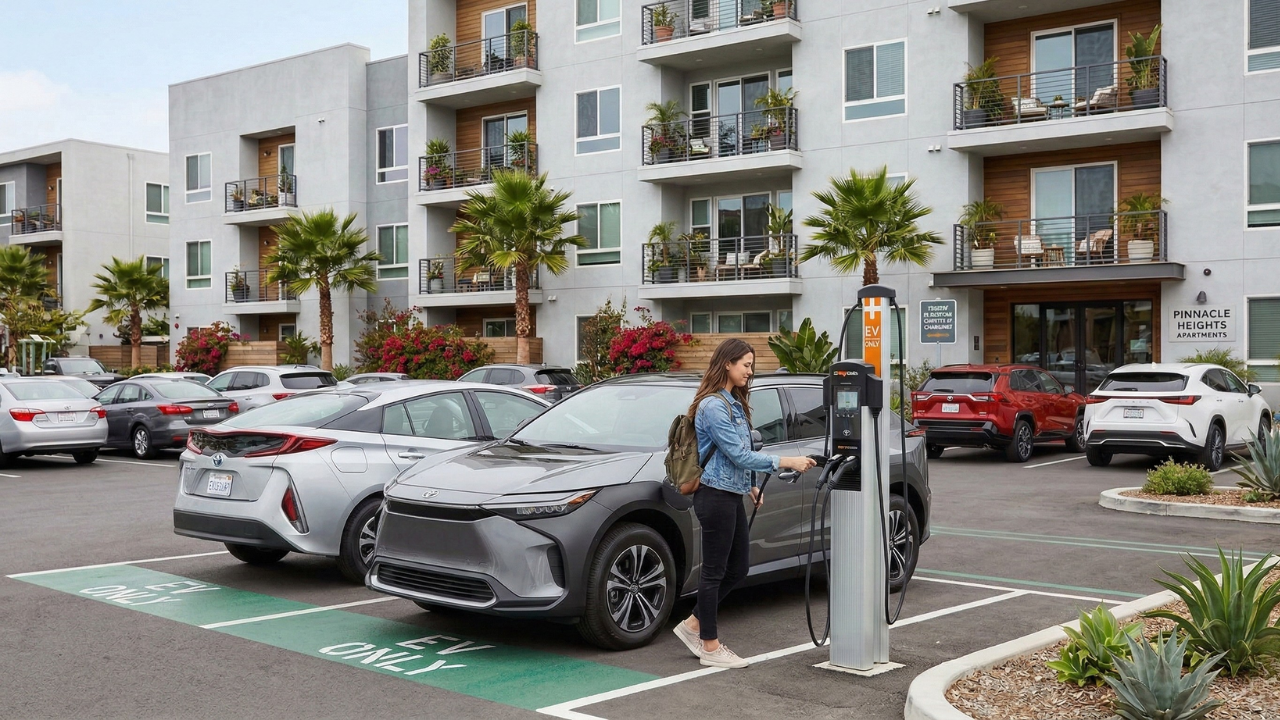
EV Charging for Apartment Renters in California: Your Options (and Your Rights)
If you rent an apartment in California and drive an electric vehicle — or you're thinking about making the switch — one of your biggest questions is probably: how do I charge at home? Unlike homeowners who can install a charger in their garage, apartment residents face unique challenges around parking access, electrical infrastructure, and landlord approvals.
The good news is that California law gives renters meaningful protections when it comes to EV charging. Understanding your rights, your responsibilities, and your options can help you secure a charging solution that works — whether that means installing your own charger or working with your landlord on a shared solution.
Your Right to Install an EV Charger Under California Law
California Civil Code Section 1947.6 protects apartment renters
California is one of the strongest states in the country when it comes to tenant EV charging rights. The key law is California Civil Code Section 1947.6, originally enacted through Assembly Bill 2565 in 2014. Here's what it establishes:
For any lease executed, extended, or renewed on or after July 1, 2015, your landlord must approve your written request to install an EV charging station at your assigned parking space — provided you meet the requirements outlined in the law.
This is not a suggestion. Under qualifying conditions, your landlord does not have the legal authority to deny a compliant request.
⚠ Important Distinction
The law does not require your landlord to pay for or provide charging infrastructure. It requires them to allow you to install a charger at your own expense. You are responsible for the costs of equipment, installation, electrical work, maintenance, and eventual removal.
Key Exemptions Renters Should Know
Civil Code §1947.6 does not apply in every situation
Your landlord is not required to approve your request if any of the following conditions exist:
| Exemption | What It Means |
|---|---|
| No parking in lease | Your lease does not include a parking space |
| Fewer than 5 spaces | The property has fewer than five total tenant parking spaces |
| 10% threshold met | EV charging stations are already installed at 10% or more of designated parking spaces |
Certain rent-controlled units also had exemptions historically, but Assembly Bill 1796 phased those out. As of January 1, 2019, tenants in rent-controlled units with leases executed, extended, or renewed after that date are covered under the law.
If none of these exemptions apply to your situation, you have a strong legal foundation for your request.
How to Submit Your EV Charging Request
A clear, detailed written request is the foundation of success
A successful request starts with a clear, detailed written letter to your landlord or property management company. While the law doesn't require specific language, your request should include:
| Include This | Details |
|---|---|
| Your identification | Full name, unit number, and the specific parking space where you want the charger installed |
| Charger type | Level 1 or Level 2, including manufacturer details and electrical specifications |
| Installation plan | Where the charger will be mounted, wiring pathways, and any structural modifications needed |
| Cost responsibility | Your acknowledgment that you will cover all costs including installation, electrical upgrades, electricity usage, maintenance, and removal |
| Code compliance | Confirmation that the installation will comply with all applicable building codes, including the California Electrical Code and NEC Article 625 |
| Approval request | A request for written approval, your contact information, and willingness to coordinate with their preferred contractors |
Attaching supporting documentation strengthens your request considerably. A licensed electrician's assessment, manufacturer spec sheets, preliminary cost estimates, and a tentative installation timeline all demonstrate preparedness and reduce landlord uncertainty.
Send your request via certified mail or another trackable delivery method so you have documented proof of submission.
For a step-by-step walkthrough of drafting your request letter, check out our guide on how to ask your landlord for an EV charger.
Insurance Requirements — and When You Can Skip Them
Senate Bill 638 removed a major barrier for tenants
One of the biggest practical wins for tenants came through Senate Bill 638, effective January 1, 2020. Previously, tenants were required to maintain a $1,000,000 general liability insurance policy for as long as the charger was installed — a significant financial barrier.
Under SB 638, the insurance requirement is eliminated entirely if both of the following conditions are met:
| Condition | What This Means |
|---|---|
| NRTL-certified charger | The EV charging station is certified by a Nationally Recognized Testing Laboratory approved by OSHA |
| Licensed electrician | All electrical work is performed by a licensed electrician |
Most major residential charger brands (ChargePoint, Grizzl-E, JuiceBox, and others) carry NRTL certification, so meeting this condition is straightforward for most installations. If either condition is not met, your landlord may require personal liability coverage up to 10 times your annual rent.
Comparing Level 1 and Level 2 Charging for Apartment Living
Choosing the right charging level for your daily driving needs
| Feature | Level 1 (120V) | Level 2 (240V) |
|---|---|---|
| Range per hour | ~3 to 5 miles | ~15 to 30 miles |
| Outlet type | Standard household outlet | Dedicated 240-volt circuit |
| Installation | Plug-and-play (minimal) | Licensed electrician required |
| Landlord approval | May not be needed if outlet exists | Formal written request required |
| Best for | Under 30 miles/day, overnight charging | Higher daily mileage, faster turnaround |
Level 1 charging uses a standard 120-volt household outlet. Most EVs include a portable Level 1 charging cable. It delivers roughly 3 to 5 miles of driving range per hour of charging — enough for renters who drive fewer than 30 miles per day and can leave their vehicle plugged in overnight. The biggest advantage for apartment residents is simplicity: if your parking space has access to a standard outlet, you may be able to charge without any special installation or landlord approval process.
Level 2 charging requires a dedicated 240-volt circuit and a separate charging unit. It delivers approximately 15 to 30 miles of range per hour, meaning a mid-range EV battery can fully recharge overnight. Level 2 is the preferred option for drivers with higher daily mileage or limited parking time. However, it requires professional installation, potential electrical panel upgrades, and the formal landlord approval process.
For many apartment residents, the decision comes down to daily driving habits. If you consistently drive under 30 miles per day and have reliable overnight parking access, Level 1 may be sufficient and far less expensive to set up. If your commute demands faster turnaround, Level 2 is the more practical long-term investment.
What EV Charger Installation Typically Costs
Understanding the cost range for California apartment settings
For Level 1 charging, costs are minimal — often just the price of a charging cable if your vehicle didn't include one, and access to an existing outlet.
For Level 2 installations, expect the following cost ranges:
| Cost Category | Typical Range |
|---|---|
| Charging unit | $400 – $1,200 |
| Electrical work (panel, wiring, conduit, labor) | $3,000 – $8,000 |
| Permitting fees | $200 – $800 |
| Total (all-in) | $5,000 – $15,000 |
Buildings with modern electrical systems and easy panel access fall near the lower end, while older buildings requiring significant rewiring or panel upgrades approach the upper range.
Financial Incentives That Can Offset Your Costs
State, federal, and utility programs can reduce your out-of-pocket expense
California utility rebates: Utility companies frequently offer rebates for Level 2 charger equipment and installation. Programs vary by provider, but rebates commonly range from $500 to $1,500 or more, with enhanced amounts available for income-qualified applicants. Contact your local utility provider directly for current programs in your area.
Federal tax credit (Section 30C): The Alternative Fuel Vehicle Refueling Property Credit provides a tax credit of up to $1,000 (30% of costs) for residential EV charger installations. Two important caveats: the property must be located in an eligible census tract (low-income or non-urban areas as defined by the IRS), and the credit is currently set to expire for property placed in service after June 30, 2026. Check IRS resources to confirm your address qualifies before counting on this credit.
💡 Tip
Research and apply for rebate programs before your installation. Some programs require pre-approval, and timing your application with your installation schedule can maximize your savings.
Negotiating with Your Landlord — Practical Tips
A collaborative approach produces better results
Even with the law on your side, a collaborative approach tends to produce better results than an adversarial one. A few strategies that can help:
Lead with preparation. Presenting a complete request package — electrician's assessment, cost estimates, insurance documentation, and a clear installation plan — signals that you've done your homework and reduces the landlord's perceived risk.
Acknowledge their concerns. Landlords often worry about liability, electrical capacity, property damage, and the impact on other tenants. Offering to use their preferred licensed contractors, agreeing to restore the parking area upon move-out, and covering all costs directly addresses those concerns.
Highlight the value to the property. EV charging is increasingly viewed as a desirable amenity that can attract and retain tenants. Landlords who invest in or allow EV infrastructure may see increased property appeal — especially as California's EV adoption continues to accelerate.
Frame it as an investment, not just a cost. Point to available rebates and incentive programs that can offset the financial impact. Some landlords may be willing to explore shared infrastructure once they understand the numbers.
What's Changing for New Construction
The 2025 CALGreen Code dramatically expands EV readiness
California's 2025 Green Building Standards Code (CALGreen), effective January 1, 2026, dramatically expands EV charging requirements for new multifamily construction. Under the updated code, every assigned parking space at a new multifamily development must include a low-power Level 2 EV charging receptacle — a major leap from the 2022 code, which required approximately 40% EV-ready coverage.
For renters, this means newer apartment buildings constructed under the 2025 code will come pre-equipped with charging infrastructure, reducing the need for individual tenant-driven installations. However, for existing apartment complexes built before these standards took effect, the tenant request process under Civil Code §1947.6 remains the primary avenue for securing EV charging access.
Explore Your EV Options at North Hollywood Toyota
If you're an apartment renter in North Hollywood, Burbank, Studio City, Valley Village, Toluca Lake, Sun Valley, or Valley Glen considering an electric vehicle, choosing the right EV makes apartment charging easier. Toyota models like the bZ4X all-electric SUV and the Prius Prime plug-in hybrid offer flexible driving ranges and smart charging features — including the ability to schedule charging during off-peak hours to reduce electricity costs.
Visit us at 4606 Lankershim Blvd, North Hollywood, CA 91602